
Self-Healing Integrations
Plumbed.io delivers self-healing enterprise integrations that stay operational and reliable through AI-managed lifecycle automation.
Visit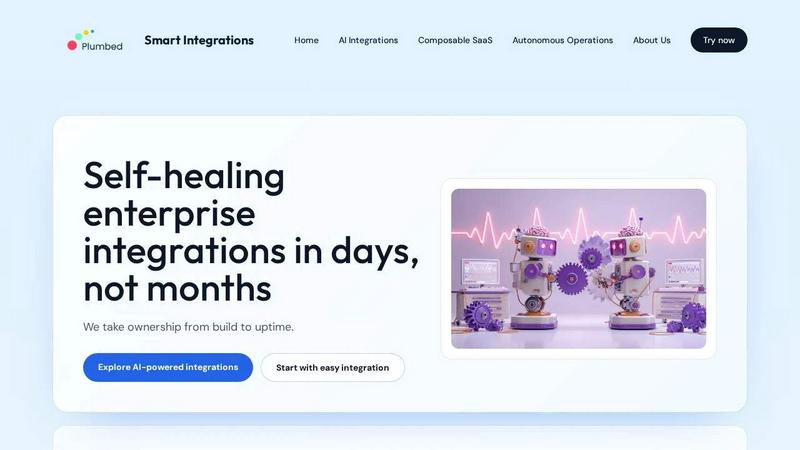
About Self-Healing Integrations
Self-Healing Integrations, powered by Plumbed.io, represent a paradigm shift in how enterprises approach the complex, ongoing challenge of connecting disparate software systems. Unlike traditional integration tools that focus solely on the initial build phase, this product is a comprehensive, AI-managed lifecycle platform designed to ensure integrations remain operational, reliable, and up-to-date long after they go live. It is specifically built for custom enterprise integrations that require continuous monitoring, proactive error handling, and frequent updates to adapt to changing business needs. The core value proposition is the elimination of the "integration tax," the hidden cost and operational overhead that makes launching new channels, systems, or partners slow and expensive. By replacing custom integration projects with an AI-native platform, Plumbed.io automates the entire lifecycle from build to maintenance. The platform is prompt-driven, production-ready, and self-healing, meaning it can automatically detect, diagnose, and resolve integration failures without human intervention. This ensures data flows continuously, engineering teams are not bogged down with maintenance, and businesses can scale efficiently. The product is ideal for organizations that are tired of brittle, point-to-point integrations that break with every update, and who seek a reliable, cost-effective way to manage a growing ecosystem of SaaS applications, APIs, and legacy systems. It takes full ownership of the integration's operational health, delivering faster launches, lower costs, and zero overhead for engineering departments.
Features of Self-Healing Integrations
AI-Powered Self-Healing Engine
The core of the platform is its intelligent, self-healing AI that actively monitors all active integrations in real-time. When an error occurs, such as a schema change, API rate limit, or a connection timeout, the AI does not simply alert a human. It automatically diagnoses the root cause, determines the appropriate corrective action, and applies the fix to restore normal data flow. This proactive error handling minimizes downtime, reduces the need for on-call engineering support, and ensures business-critical data pipelines remain operational 24/7 without manual intervention.
Automated Integration Lifecycle Management
Plumbed.io goes beyond simple monitoring by automating the entire integration lifecycle. This includes the initial build, deployment, ongoing monitoring, proactive maintenance, and continuous system updates. As connected SaaS applications release new versions or deprecate old endpoints, the platform intelligently adapts the integrations to maintain compatibility. This eliminates the tedious and error-prone manual work of tracking changes across dozens of systems, ensuring that integrations are always running on the most current and stable versions of each connected service.
Prompt-Driven, Production-Ready Setup
Traditional integration projects require weeks of custom coding and configuration. Plumbed.io revolutionizes this process with a prompt-driven interface. Users can describe the integration they need in natural language, and the platform's AI generates the necessary connection logic, data mappings, and transformation rules. This dramatically reduces the time to value, allowing enterprises to deploy new connections in days, not months. Furthermore, every integration built through this method is inherently production-ready, designed for high availability and performance from the moment it is deployed.
Composable SaaS Architecture
The platform is built on a composable SaaS architecture, allowing users to connect systems in a modular and flexible manner. Instead of building monolithic, fragile integrations, users can assemble pre-built connectors and logic blocks like building blocks. This approach makes it easy to add, remove, or modify individual components of an integration without disrupting the entire workflow. This modularity is crucial for scaling, as it allows businesses to quickly adapt their integration landscape to new partners, channels, or internal requirements without incurring significant re-engineering costs.
Use Cases of Self-Healing Integrations
High-Volume E-commerce Order Management
An e-commerce company connects its Shopify store to a legacy ERP system and a third-party logistics provider. Traditional integrations fail frequently due to inventory sync errors or order format mismatches. With Self-Healing Integrations, the AI continuously monitors the data flow. If an order fails to sync due to a missing SKU, the system can automatically flag the issue, pause the transaction, and attempt to reconcile the data from a secondary source, ensuring no orders are lost and the fulfillment pipeline remains uninterrupted.
Real-Time CRM and Marketing Automation Sync
A B2B SaaS company needs to keep its Salesforce CRM and HubSpot marketing automation platform in perfect sync. Any break in this integration leads to lost leads and poor customer experiences. The self-healing platform automatically handles API rate limits from either system, retries failed data transmissions with exponential backoff, and adapts to field mapping changes when either platform updates its schema. This ensures that lead scores, contact details, and campaign memberships are always accurate and up-to-date without manual oversight.
Financial Data Aggregation for Reporting
A financial services firm aggregates transaction data from multiple banking APIs into a central data warehouse for compliance and analytics. These APIs are notoriously unstable and frequently change their authentication protocols or data formats. Plumbed.io's AI monitors each connection, and if a bank API returns an error, the system can automatically re-authenticate using stored credentials or switch to a backup data feed. This guarantees that critical financial reports are generated on time, every time, without requiring engineering to manually fix broken data pipelines.
Multi-Channel Supply Chain Integration
A manufacturer integrates with several suppliers, each using different EDI standards or API formats. Manually maintaining these connections is a nightmare. Using the platform, the manufacturer can deploy a new supplier integration in days using the prompt-driven interface. Once live, the self-healing AI manages the ongoing complexity. If a supplier changes their order confirmation format, the AI detects the anomaly, learns the new structure, and automatically updates the data mapping, preventing order delays and ensuring the supply chain remains resilient.
Frequently Asked Questions
How does the self-healing AI actually work?
The AI continuously monitors every transaction flowing through an integration. It uses machine learning models to establish a baseline of normal behavior, including data formats, response times, and error codes. When an anomaly is detected, such as a new error type or a change in API response structure, the AI analyzes the failure context. It then executes a pre-defined or dynamically generated remediation script, which could involve retrying the request, updating authentication tokens, modifying data mappings, or re-routing traffic. The system logs all actions for auditability and continuously learns from its successes and failures to improve future responses.
Is this platform suitable for small businesses or only large enterprises?
While the product is designed to handle the complexity of custom enterprise integrations, its prompt-driven setup makes it accessible for businesses of all sizes. Small to medium-sized businesses benefit from the "faster launches" and "lower costs" aspects, as they can connect their core SaaS tools without needing a dedicated integration engineer. However, the full value of the autonomous operations and self-healing capabilities is most impactful for larger organizations with many critical, custom integrations that require high uptime and minimal operational overhead.
What happens if the AI cannot fix an integration error?
The platform is designed to handle the vast majority of common errors autonomously. However, if the AI encounters a novel or complex issue it cannot resolve, it does not leave the integration in a broken state. Instead, it will gracefully pause the affected data flow, generate a detailed diagnostic report including the failure context and attempted fixes, and automatically alert the designated engineering team. This ensures that human intervention is only required for the most challenging edge cases, dramatically reducing the mean time to resolution (MTTR) compared to traditional monitoring.
How long does it take to set up a new integration?
One of the key value propositions is speed. For standard connections between popular SaaS applications, a new integration can often be set up and deployed in minutes using the prompt-driven interface. For more complex, custom integrations involving legacy systems or intricate business logic, the setup time is typically reduced from months to days. The platform provides a guided, AI-assisted workflow that handles the heavy lifting of API discovery, authentication, and data mapping, allowing users to focus on defining the business rules.
Explore more in this category:
Similar to Self-Healing Integrations


Free Chrome extension. Paste your rough point and Chrome's built-in AI writes a fresh reply for that post on X, LinkedIn, Facebook or Instagram.

Turn a photo of your pet into new pictures or short animations with AI. Sign in for a free 1K image daily.

Signage and kiosk infrastructure for AI agents. Your agent publishes images, video, streams, web pages and apps to screens via one plugin.screenRIG is

ReadyData is an online PDF to Excel converter powered by AI. It helps users extract tables and relevant fields from invoices, bank statements, reports

A comprehensive suite of browser-side financial planners, health trackers, and developer utilities running completely on your terms.

Free YouTube transcripts on the web, a Chrome extension, and an API + MCP server so AI assistants can read YouTube.
