
LLM Reference
LLM Reference helps tech leaders quickly find and compare models, providers, and benchmarks to pick the right AI for every project.
Visit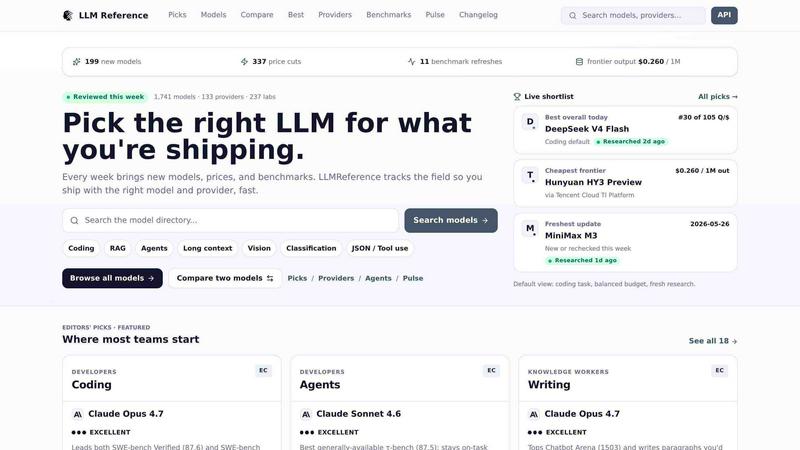
About LLM Reference
LLM Reference is a decision-support directory built for engineers and technology leaders who need to choose the right large language model (LLM) and provider in today's fast-moving AI landscape. It tracks over 1,800 language models from more than 140 providers and 247 research labs, with data refreshed daily to include new releases, verified price changes, and benchmark updates. The core value proposition is simple: stop wasting time hunting through scattered sources and start shipping with confidence. Whether you are building a coding assistant, an agentic workflow, a writing tool, or a research pipeline, LLM Reference gives you a single, trustworthy place to compare models side-by-side, see who offers the cheapest pricing for frontier output, and browse curated editors' picks for specific tasks like coding, agents, writing, research, image generation, and video creation. The site is designed for fast triage, allowing you to quickly identify the right model for your job, determine the most cost-effective provider, and get back to building. With a Pulse feed that highlights what changed this week, including new models, price cuts, and benchmark refreshes, LLM Reference keeps you informed without the noise. It is built by the Data Advantage project and updated daily, making it an essential resource for anyone who needs to stay current with the exploding LLM ecosystem. The platform covers every major category including coding, RAG, agents, long context, vision, classification, and JSON or tool use.
Features of LLM Reference
Comprehensive Model Directory
LLM Reference maintains a searchable directory of over 1,800 language models from more than 140 providers and 247 labs. You can search by model name, provider, task type, or benchmark performance. The directory is updated daily, ensuring you always have access to the latest releases, price changes, and benchmark scores. This eliminates the need to manually track multiple sources for model information.
Editors' Picks and Curated Boards
The platform features expert-curated editors' picks for six key task categories: coding, agents, writing, research, image generation, and video creation. Each pick includes detailed rationale, benchmark evidence, and alternative recommendations. Additionally, 18 leaderboards are organized by audience type, including developers, knowledge workers, and creatives, making it easy to find the best model for any specific use case.
Pulse Feed and Weekly Changes
The Pulse feed provides a weekly summary of what changed in the model market, including new models, verified price cuts, and benchmark refreshes. Users can quickly see that 177 new models were added, 53 price cuts were verified, and 368 benchmark refreshes occurred in a given week. This feature keeps you informed about market movements without requiring constant manual monitoring.
Side-by-Side Model Comparison
Users can compare two models directly on the platform, viewing performance across multiple benchmarks, pricing details, and provider options. The comparison tool includes a cheat sheet section featuring the most-asked comparisons, such as Claude Fable 5 versus GPT-5.5 or Claude Opus 4.8 versus Claude Opus 4.7. This enables rapid, data-driven decision making for model selection.
Use Cases of LLM Reference
Selecting a Coding Assistant Model
Engineering teams building coding assistants or developer tools can use LLM Reference to identify the best model for their specific needs. The coding leaderboard highlights Claude Fable 5 as the top pick, with an 80.3 percent SWE-bench Pro score and 96 percent SWE-bench Verified on Vals.ai. Users can compare pricing across providers and find the most cost-effective option for their coding workload.
Choosing an Agentic Workflow Model
Teams building agentic workflows or autonomous systems can leverage the agents leaderboard and editors' picks to find models that excel at tool use and self-correction. Claude Sonnet 4.6 is recommended for its 87.5 tau-bench score and ability to stay on-task across long tool loops. The platform also provides alternative picks like Claude Fable 5 and GLM-5 for different requirements.
Identifying Cost-Effective Frontier Models
Technology leaders looking to minimize costs while maintaining frontier performance can use the frontier pricing tracker. The platform shows the cheapest frontier output price, currently $0.260 per 1 million output tokens via Hunyuan HY3 Preview through Tencent Cloud TI Platform. Users can filter by provider and model to find the best price-performance ratio for their specific use case.
Comparing Image and Video Generation Models
Creative professionals and media teams can use the creatives leaderboard to find the best image and video generation models. FLUX.2 Dev is the top pick for image generation, known for photorealistic output, brand consistency, and excellent text rendering. Veo 3.1 leads for video generation, offering 30-second clips with native audio and up to 4K resolution through Vertex AI.
Frequently Asked Questions
How often is the model directory updated?
The model directory is updated daily, with data refreshed to include new releases, verified price changes, and benchmark updates. A weekly Pulse feed summarizes the most significant changes, including new models, price cuts, and benchmark refreshes. This ensures users always have access to the most current information in the rapidly evolving LLM landscape.
How are editors' picks determined?
Editors' picks are curated by the LLM Reference team based on a combination of benchmark performance, real-world testing, and expert analysis. Each pick includes detailed rationale, supporting benchmark scores, and alternative recommendations. Picks are regularly reviewed and updated as new models and benchmarks become available, with freshness indicators showing when each pick was last researched.
Can I compare models from different providers?
Yes, the platform includes a dedicated comparison tool that allows you to compare two models side-by-side. You can view performance across multiple benchmarks, pricing details, and provider options. The cheat sheet section also features the most-asked comparisons, such as Claude Fable 5 versus GPT-5.5 or Claude Opus 4.8 versus Claude Opus 4.7, to help you make informed decisions quickly.
What types of tasks does LLM Reference cover?
LLM Reference covers a wide range of tasks including coding, agents, tool use, writing, research, summarization, document Q&A, translation, data and SQL, image generation, video generation, voice and text-to-speech, transcription, music generation, and image editing. Each task category has its own leaderboard and editors' picks, making it easy to find the best model for your specific application.
Similar to LLM Reference

Turn a photo of your pet into new pictures or short animations with AI. Sign in for a free 1K image daily.

Signage and kiosk infrastructure for AI agents. Your agent publishes images, video, streams, web pages and apps to screens via one plugin.screenRIG is

A comprehensive suite of browser-side financial planners, health trackers, and developer utilities running completely on your terms.

Free YouTube transcripts on the web, a Chrome extension, and an API + MCP server so AI assistants can read YouTube.

Moderation, routing, intent and scoring for any text over one Jev-compatible API, hosted in the EU.


