
Autheo
Autheo is a Layer-0 operating system with an integrated Layer-1 blockchain that unifies identity, compute, storage, AI, and developer tools into one.
Visit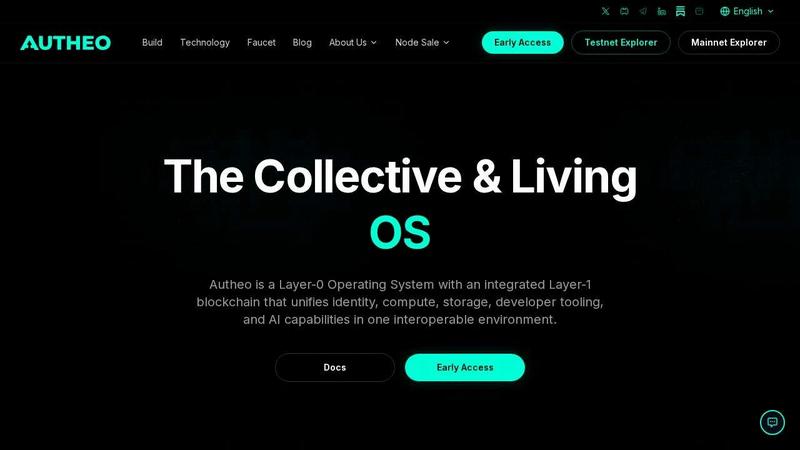
About Autheo
Autheo is a Layer-0 Operating System with an integrated Layer-1 blockchain designed to solve the fragmentation problem that plagues Web3. Developers today are forced to juggle multiple APIs, SDKs, and platforms while enterprises struggle with the gulf between Web2 and Web3 systems. Autheo addresses this by unifying identity, compute, storage, developer tooling, and AI capabilities into one interoperable environment. The platform is built for developers, enterprises, and innovators who want to launch scalable applications, sovereign ecosystems, and interoperable networks without piecemeal integrations. At its core, Autheo provides a composable, programmable, and sovereign foundation where builders can stop renting infrastructure and start owning the internet itself. The system includes DevHub as its native development environment, allowing for seamless testing, deployment, and scaling of projects. Autheo is more than technology; it is a living movement supported by over 100 co-founders and contributors across blockchain, AI, gaming, open-source, and infrastructure sectors. The platform is designed to learn, adapt, and evolve over time as AI-native tools and agents join the stack, creating an intelligent, integrated internet where Web2 and Web3 converge.
Features of Autheo
Layer-0 and Layer-1 Blockchain Foundation
Autheo combines a Layer-0 operating system with an integrated Layer-1 blockchain to provide a fast, sovereign, and secure foundation for building decentralized applications. This dual-layer architecture ensures high performance, scalability, and interoperability while maintaining full sovereignty for developers. The Layer-0 base handles network coordination and cross-chain communication, while the Layer-1 chain processes transactions and executes smart contracts. This design allows builders to launch their own chains, applications, and intelligent systems that work seamlessly from day one, eliminating the need for complex multi-platform integrations.
Core Infrastructure with Decentralized Cloud
The platform includes a robust decentralized infrastructure layer that provides cloud computing, data storage, and messaging capabilities. This core infrastructure is fully decentralized, ensuring that applications built on Autheo benefit from distributed resources that are resistant to censorship and single points of failure. Developers can leverage this infrastructure to build scalable applications without worrying about centralized cloud provider limitations. The decentralized cloud component handles compute workloads, while the storage system ensures data persistence and availability, and the messaging layer enables real-time communication between different components of the ecosystem.
Full-Stack SDKs for Unified Development
Autheo provides comprehensive full-stack SDKs that cover frontend development, backend logic, smart contract creation, and system orchestration within a single framework. This unified approach eliminates the need for developers to learn and integrate multiple disparate tools and libraries. The SDKs are designed to work seamlessly with the DevHub environment, enabling rapid prototyping and deployment. Developers can build complex applications that span multiple layers of the stack using consistent programming paradigms and APIs, significantly reducing development time and complexity while ensuring compatibility across all components of the Autheo ecosystem.
TheoID for Post-Quantum Secure Authentication
TheoID is a revolutionary identity system that provides post-quantum secure authentication and sovereignty for both people and digital assets. This feature ensures that identities and assets remain secure even against future quantum computing threats, making Autheo future-proof. TheoID gives users full control over their digital identities, enabling self-sovereign identity management that works across the entire Autheo ecosystem and beyond. This component is critical for applications requiring high security, such as financial services, healthcare, and enterprise systems, where identity verification and asset ownership must be guaranteed.
Use Cases of Autheo
Building Sovereign Decentralized Applications
Developers can use Autheo to build fully sovereign decentralized applications that operate independently of centralized infrastructure. The platform provides all the necessary components including compute, storage, identity, and AI capabilities in one integrated environment. This allows developers to create applications that are truly decentralized, with no single point of failure or control. Whether building DeFi protocols, NFT marketplaces, or governance systems, developers can launch applications that are scalable, secure, and interoperable with other chains and systems through Autheo's Layer-0 architecture.
Enterprise Web2 to Web3 Migration
Enterprises looking to transition from traditional Web2 systems to Web3 infrastructure can use Autheo as a bridge. The platform's unified environment simplifies the migration process by providing familiar developer tooling alongside blockchain capabilities. Enterprises can gradually move their operations to decentralized infrastructure without disrupting existing workflows. Autheo's identity system, TheoID, enables enterprises to maintain user authentication and data sovereignty throughout the transition. This use case is particularly valuable for companies in finance, supply chain, and healthcare that need to adopt blockchain technology while maintaining compliance and security standards.
AI-Powered Autonomous Systems
Autheo's integration of AI capabilities with blockchain infrastructure enables the creation of intelligent, autonomous systems that can learn and adapt over time. Developers can build AI agents that interact with smart contracts, manage digital assets, and automate complex workflows. These AI-native systems become part of the living network, contributing to its evolution and intelligence. Use cases include automated trading bots, intelligent supply chain management, predictive analytics platforms, and autonomous governance systems that make decisions based on real-time data and machine learning models.
Decentralized Identity and Asset Management
TheoID enables sophisticated decentralized identity and digital asset management solutions. Users can create self-sovereign identities that work across multiple applications and platforms within the Autheo ecosystem. This use case extends to digital asset management, where users can securely store, transfer, and manage tokens, NFTs, and other digital assets with post-quantum security. Organizations can implement verifiable credential systems, decentralized KYC processes, and identity-based access control for their applications. This is essential for building trust in decentralized systems while maintaining user privacy and control.
Frequently Asked Questions
What is Autheo?
Autheo is a Layer-0 Operating System with an integrated Layer-1 blockchain that unifies identity, compute, storage, developer tooling, and AI capabilities in one interoperable environment. It is designed to solve the fragmentation problem in Web3 by providing a single foundation where developers and enterprises can launch scalable applications, sovereign ecosystems, and interoperable networks without needing to integrate multiple disparate platforms and tools.
What can I build on Autheo?
You can build a wide range of applications on Autheo, including decentralized applications (dApps), sovereign blockchain networks, AI-powered autonomous systems, decentralized identity solutions, and enterprise-grade Web3 infrastructure. The platform supports everything from DeFi protocols and NFT marketplaces to supply chain management systems and intelligent automation platforms. The DevHub environment provides native tools for testing, deploying, and scaling these projects.
How is Autheo different from Ethereum or Solana?
Autheo differs from Ethereum and Solana in several key ways. First, Autheo is a Layer-0 operating system with an integrated Layer-1 blockchain, rather than just a single-layer blockchain. This architecture provides greater flexibility and interoperability. Second, Autheo unifies identity, compute, storage, developer tooling, and AI capabilities into one environment, while Ethereum and Solana focus primarily on smart contract execution. Third, Autheo includes TheoID for post-quantum secure authentication, which is not available on other platforms.
Is Autheo live?
Autheo is currently in development and offers Early Access for builders and developers who want to be among the first to explore and contribute to the platform. The team has released a Testnet Explorer for testing purposes, and a Mainnet Explorer is also available. The Node Sale is active, allowing participants to become validators on the network. Interested developers can sign up for Early Access through the official Autheo website to get started with building on the platform.
Similar to Autheo


A Polymarket trading bot automating a proven arbitrage and directional strategy for 5-15 minute Bitcoin Up or Down markets, with full source code.


Bitcoin Loans Market lets you compare Bitcoin-backed loans effortlessly, simplifying your choices with clear terms and live rates.

MadeOnSol ranks 1,065 Solana tools, tracks 1,069 KOL wallets live, and provides intel, alerts, and an API.

Perpfinder delivers a structured, categorized dashboard for comparing live volume, fees, and open interest across 30+ crypto perpetual exchanges.

CreateMyCoin enables anyone to effortlessly launch a Solana token in just 60 seconds, with no coding skills required.

Collab Chain transforms royalty statements into verifiable, tamper-evident proof of music credits and earnings.