
StockFit API
StockFit API delivers standardized, model-ready SEC data for valuation and backtesting with sector-aware metrics.
Visit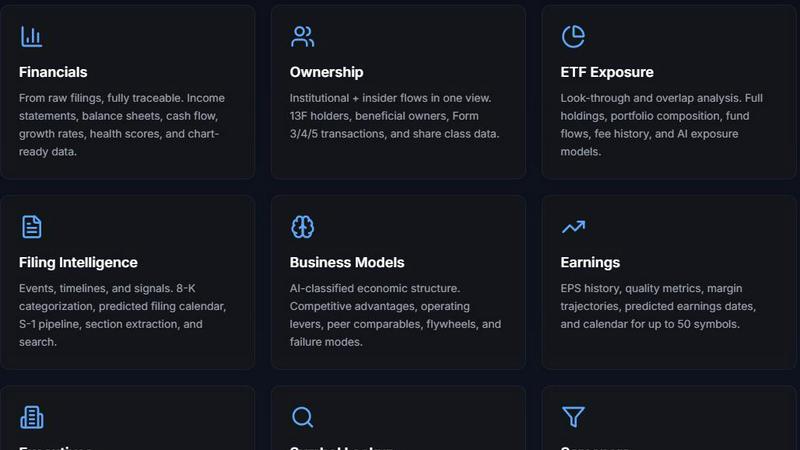
About StockFit API
StockFit API is a specialized financial data platform that provides developers, quants, and research platforms with direct, unaltered access to SEC filing data. The core problem StockFit solves is the common tradeoff in financial APIs where users must choose between affordable but inaccurate data tiers and expensive enterprise contracts that strain startup budgets. StockFit fills this gap by delivering fundamentals, ownership data, ETF and mutual fund exposure, insider transactions, and filings all pulled directly from SEC XBRL filings with no derived middle layer. Every number is traceable back to its original filing, ensuring complete transparency and auditability.
The platform is built for real-world financial modeling and backtesting. It handles complex edge cases that other APIs ignore: amended filings are properly managed, non-December fiscal years are computed correctly, and Q4 data is reconstructed from 10-K and 10-Q filings. Beyond raw financial data, StockFit provides rich economic models per company covering offerings, peers, operating levers, competitive advantages, flywheels, strategic initiatives, and failure modes. For ETF and mutual fund exposure, the platform offers detailed models covering mandate, portfolio construction, costs, sensitivities, and use cases. With over 250 million facts sourced from more than 5 million filings and updated daily, StockFit delivers comprehensive coverage. The API is accessible via standard REST endpoints and includes a native MCP server for seamless integration with Claude, Cursor, and other AI tools, making it particularly well-suited for LLM-driven workflows.
Features of StockFit API
Direct SEC XBRL Data Access
StockFit pulls financial data directly from SEC XBRL filings without any derived or interpolated middle layer. This means every financial fact, from revenue to earnings per share, is an exact copy of what companies reported to the SEC. Users benefit from complete data integrity and the ability to trace any number back to its original filing document. This eliminates the accuracy issues common in cheaper API tiers and provides the confidence needed for serious quantitative analysis and backtesting.
Intelligent Fiscal Period Handling
The API intelligently handles complex fiscal calendar scenarios that cause errors in other financial data providers. Amended filings are automatically detected and incorporated correctly. Non-December fiscal year ends are computed accurately, ensuring that financial periods align with a company's actual reporting schedule. Q4 data is reconstructed from the combination of 10-K and 10-Q filings, providing complete annual figures even when companies do not report a standalone Q4. This feature is critical for building accurate time-series models and performing year-over-year comparisons.
Comprehensive Economic and Exposure Models
Beyond standard financial statements, StockFit provides rich economic models for each company. These models cover offerings, peer comparisons, operating levers, competitive advantages, business flywheels, strategic initiatives, and potential failure modes. For ETF and mutual fund exposure, the platform offers detailed models that include mandate analysis, portfolio construction methodology, cost structures, sensitivity analysis, and use case categorization. These models are specifically designed to be AI-friendly for LLM workflows, enabling natural language queries and automated analysis.
Native MCP Server Integration
StockFit includes a native Model Context Protocol (MCP) server for direct integration with AI tools like Claude and Cursor. This allows users to query financial data using natural language commands directly from their AI assistant. The MCP server handles authentication, data formatting, and context management, making it simple to incorporate financial data into AI-powered research, analysis, and development workflows. This feature significantly reduces the technical overhead of building custom integrations.
Use Cases of StockFit API
Quantitative Backtesting and Strategy Development
Quantitative analysts and algorithmic traders can use StockFit to build and backtest investment strategies with reliable, source-verified data. The standardized financials and sector-aware metrics ensure that models are built on consistent data across different companies and time periods. The ability to handle non-December fiscal years and amended filings means backtests accurately reflect the data available at each historical point. Developers can pull decades of financial data for thousands of companies to train machine learning models and validate trading hypotheses.
AI-Powered Financial Research and Analysis
Research platforms and individual analysts can leverage StockFit's AI-friendly data structures and MCP server to perform deep financial analysis using natural language. Users can ask complex questions about a company's financial health, competitive position, or industry trends and receive structured, source-cited answers. The economic models provide ready-made frameworks for analyzing business moats, operating leverage, and strategic initiatives. This use case is particularly valuable for investment research firms looking to automate parts of their analysis workflow.
Portfolio and Exposure Management
Asset managers and wealth advisors can use StockFit to analyze portfolio composition and exposure in detail. The ETF and mutual fund exposure models provide insights into mandate compliance, portfolio construction, cost analysis, and sensitivity to market factors. Users can understand exactly how their investments are exposed to different sectors, geographies, and risk factors. The ownership data allows for monitoring of insider transactions and institutional holdings, providing early signals of management sentiment and smart money movements.
Corporate Valuation and Merger Analysis
Investment bankers, corporate development teams, and valuation professionals can use StockFit for detailed company valuation and merger analysis. The standardized financials make it easy to build discounted cash flow models, comparable company analyses, and precedent transaction analyses. The peer comparison models provide ready-made peer groups for benchmarking. The economic models offer insights into competitive advantages and failure modes that are critical for assessing merger synergies and risks. Every data point is traceable to its source, which is essential for regulatory compliance and audit trails.
Frequently Asked Questions
How does StockFit ensure data accuracy compared to other financial APIs?
StockFit pulls data directly from SEC XBRL filings with no derived or interpolated middle layer. Every financial fact is an exact copy of what companies reported to the SEC, and each number is traceable back to its original filing document. This eliminates the accuracy drift that occurs when APIs transform or aggregate data. Additionally, StockFit handles complex scenarios like amended filings and non-December fiscal years correctly, preventing common data errors that plague other providers.
Can I use StockFit with AI tools like Claude or Cursor?
Yes, StockFit includes a native Model Context Protocol (MCP) server specifically designed for integration with Claude, Cursor, and other AI tools. This allows you to query financial data using natural language commands directly from your AI assistant. The MCP server handles authentication, data formatting, and context management, making it simple to incorporate financial data into AI-powered research and analysis workflows without building custom integrations.
What types of financial data does StockFit provide?
StockFit provides a comprehensive range of financial data including standardized financial statements (income statement, balance sheet, cash flow), fundamentals, ownership data, ETF and mutual fund exposure, insider transactions, and raw filings. The platform also offers rich economic models per company covering offerings, peers, operating levers, competitive advantages, flywheels, strategic initiatives, and failure modes. For ETFs and mutual funds, models cover mandate, portfolio construction, costs, sensitivities, and use cases.
How frequently is the data updated and how much historical data is available?
StockFit is updated daily with new filings as they become available from the SEC. The platform contains over 250 million facts sourced from more than 5 million filings, providing extensive historical coverage. This allows users to perform long-term backtesting and analysis across multiple market cycles. The daily updates ensure that you have access to the most current financial data for real-time analysis and decision-making.
Explore more in this category:
Similar to StockFit API


All-in-One POS, Inventory & Accounting Software for Bangladeshi Businesses


