
Opal
Opal is a visual workspace that organizes all your projects and notes so you can find anything instantly.
Visit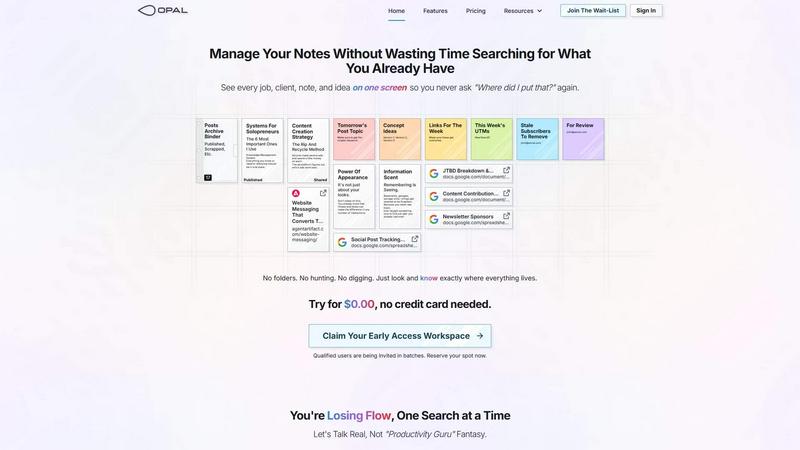
About Opal
Opal is a visual knowledge and project management workspace engineered for individuals who think and work spatially. It directly addresses the chronic frustration of losing critical information in nested folders, complex dashboards, or buried notes within traditional productivity apps. Opal's core innovation is an infinite digital canvas that mimics the intuitive organization of a physical desk. Users can freely drag, drop, group, and arrange notes, documents, files, and links, creating a visual map of their work. This leverages spatial memory—the brain's innate ability to remember where something is located—making information retrieval instant and contextually clear. Designed for solopreneurs, consultants, agency owners, writers, and any professional whose business hinges on conversations, details, and client promises, Opal ensures your entire ecosystem of active projects, client details, and creative ideas remains visible and top-of-mind. By eliminating the constant search for buried data, Opal restores flow, prevents costly context-switching, and empowers you to execute your best work with clarity and confidence.
Features of Opal
Infinite Visual Canvas
Opal provides a boundless digital workspace where you can lay out all elements of your work. Unlike restrictive folder hierarchies or linear lists, this canvas allows for free-form arrangement. You can cluster related client notes, stack project drafts, or position reference links adjacent to relevant tasks, creating a personalized and intuitive spatial layout that your brain naturally memorizes.
Spatial Memory Organization
This feature is the cognitive foundation of Opal. By placing information in a specific, fixed location on your canvas, you engage your brain's powerful spatial recall. You stop relying solely on filenames or search terms and start remembering that the client contract is to the left of the project brief and above the meeting notes. This transforms retrieval from a hunting exercise into a simple act of looking and knowing.
Multi-Item Side-by-Side Viewing
Opal enables you to open and view multiple notes, documents, or files simultaneously, limited only by your screen size. This is critical for workflows requiring comparison, synthesis, or reference, such as drafting content while reviewing source materials or managing multiple client details during a planning session, all without constant tab switching or window management.
Direct Embedding of Links & Files
You can seamlessly drag and drop or embed a wide variety of external content directly onto your Opal canvas. This includes web links, Google Docs, Sheets, PDFs, images, and more. These items become persistent, visual objects in your workspace, preventing them from disappearing into browser bookmark abyss and keeping critical resources directly within your line of sight.
Use Cases of Opal
Content Creation & Editorial Management
Content creators and writers can use Opal to visually map their entire editorial process. The canvas can hold clusters for topic ideas, drafts in various stages (outline, version 1, for review), published posts, keyword lists, and tracking sheets. This provides an at-a-glance view of the content pipeline, preventing ideas from getting lost and ensuring deadlines are met.
Client & Project Management for Solopreneurs
Consultants and solo agency owners can dedicate canvas areas to each client or project. Within each area, they can place meeting notes, project briefs, contract links, communication logs, and task lists. This spatial separation keeps all context for a specific client contained and immediately accessible, streamlining management and enhancing client service.
Research & Knowledge Synthesis
Researchers, students, or strategists can use Opal to collect and organize information from diverse sources. Quotes, article links, data points, and personal insights can be placed and grouped thematically on the canvas. This visual arrangement facilitates pattern recognition, idea connection, and the synthesis of complex information into coherent narratives or reports.
Business System & SOP Visualization
Business owners can build visual systems dashboards on their Opal canvas. Key operating documents—like standard operating procedures (SOPs), financial tracking sheets, marketing calendars, and CRM links—can be positioned logically. This creates a permanent, visual command center for the business's essential systems, ensuring they are always seen and utilized.
Frequently Asked Questions
How is Opal different from tools like Notion or Trello?
While Notion uses databases and pages and Trello uses linear lists, Opal is built on a foundational principle of spatial, free-form canvas organization. It does not force information into pre-defined tables, cards, or nested pages. Instead, it allows you to place items anywhere, leveraging your brain's spatial memory for recall. It's less about filing and more about creating a persistent, visual map of your work.
Is Opal suitable for team collaboration?
Based on the provided context, Opal appears primarily designed for individual use as a personal visual workspace for solopreneurs and independent professionals. The focus is on managing one's own universe of projects, clients, and ideas. Features for real-time multi-user collaboration are not highlighted in the current material.
Can I try Opal before committing?
Yes, Opal offers a free trial that requires no credit card to begin. You can register to claim an Early Access workspace URL and experience the infinite canvas and spatial organization features firsthand to determine if the workflow aligns with your thinking and business management style.
What kind of items can I put on the Opal canvas?
You can place a versatile range of items directly onto your Opal workspace. This includes text notes, website links, and embedded previews or links to files from common platforms like Google Docs, Google Sheets, and PDFs. This turns your canvas into a unified hub for both your original thoughts and critical external resources.
Pricing of Opal
The provided content indicates that Opal is currently in an Early Access phase and can be tried for $0.00 with no credit card required. Specific pricing plans, tiers, or long-term subscription costs are not detailed in the available context. Interested users are encouraged to register to claim their workspace and likely receive further information on future pricing directly.
Similar to Opal

Panzoe is an all-in-one AI platform for personal productivity, business automation, AI assistants, content creation, and custom AI solutions.

AI Email Filter sorts incoming mail into folders using plain-language prompts you write. Works with any IMAP mailbox; bring your own LLM if you want.

No-code 2D game editor: visual node logic, drag-and-drop scenes, live preview. Exports to Windows, macOS, Linux, Android, iOS, Web.

Free collection of online developer utilities, code formatters, and digital converters designed to streamline your daily workflow.

Online tally counter for tracking attendance, workouts, inventory, visitors, sports scores, habits, and everyday counting tasks.

The #1 Native Form Builder Plugin for Framer - No Code, No Embeds, No External Platforms.

A free launch checklist for SaaS, apps, AI tools and more. Every step says why it matters and when you can skip it.

Practical, independent guides to home repairs, maintenance, costs, troubleshooting, and everyday fixes.