
Blueberry vs Fallom
Side-by-side comparison to help you choose the right product.

Blueberry
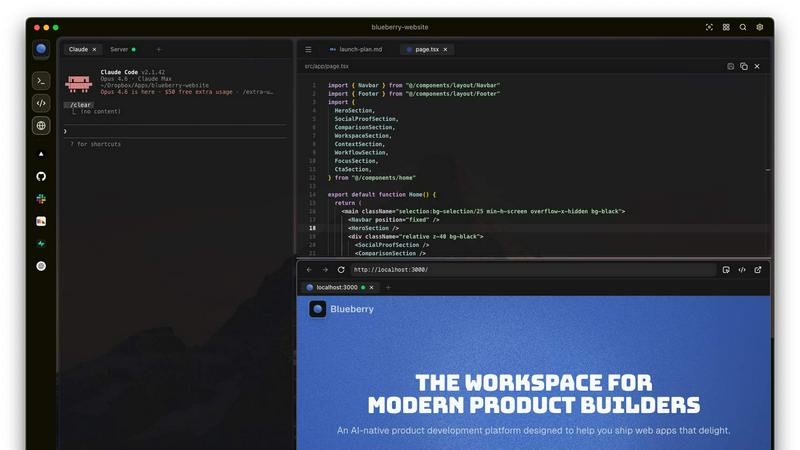
Blueberry is an all-in-one Mac app that integrates your editor, terminal, and browser for seamless web app development.
Last updated: February 26, 2026

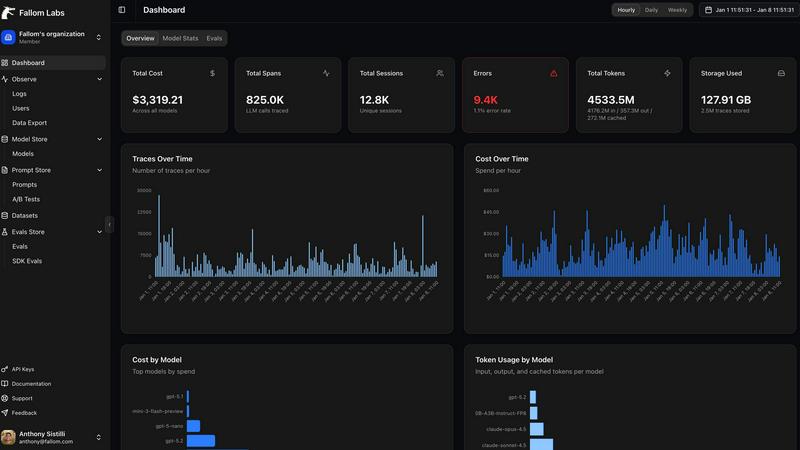
Fallom is an AI observability platform for tracking and optimizing LLM and agent operations.
Last updated: February 28, 2026
Visual Comparison
Blueberry
Fallom
Feature Comparison
Blueberry
Integrated Workspace
Blueberry combines a code editor, terminal, and preview browser into a single workspace, allowing developers to build and deploy applications without switching between multiple applications. This integration saves time and reduces cognitive load.
AI Integration with MCP
With Blueberry's Model Communication Protocol, developers can connect AI models directly to their workspace. These models gain access to files, terminal outputs, and live previews, providing contextual assistance that enhances coding and debugging processes.
Multi-Device Preview
Blueberry supports multi-device previews, enabling users to see how their applications will appear on desktops, tablets, and mobile devices. This built-in feature helps developers ensure a consistent user experience across different platforms without leaving the workspace.
Customizable Command Bar
The command bar in Blueberry allows users to quickly launch files, switch projects, and execute commands from a single keyboard shortcut. This customization enhances efficiency, giving developers the ability to tailor their workflows to suit individual needs.
Fallom
End-to-End LLM Tracing
Fallom provides comprehensive tracing for every LLM call, capturing granular details in real-time. This includes the full prompt, model output, any function or tool calls made, token counts, latency metrics, and the calculated cost per call. This deep visibility is essential for debugging complex agentic workflows, understanding performance bottlenecks, and gaining a precise view of operational costs.
Cost Attribution and Transparency
The platform offers detailed cost tracking and attribution, breaking down spend by model, team, user, or customer. This provides full financial transparency for budgeting, forecasting, and internal chargeback processes. Teams can monitor live usage, set alerts for budget overruns, and make informed decisions about model selection based on both performance and cost-efficiency.
Compliance-Ready Audit Trails
Fallom is built for regulated industries, providing immutable, complete audit trails of every AI interaction. This includes full input/output logging, model versioning, and user consent tracking. These features are designed to help organizations meet stringent regulatory requirements such as the EU AI Act, SOC 2, and GDPR, ensuring accountability and traceability in AI operations.
Session Tracking and User Context
Group individual traces into complete user sessions to understand the full customer journey. This feature provides context for interactions, allowing teams to analyze how users engage with AI features, troubleshoot specific customer issues, and calculate the total cost-to-serve per user or account, enabling better product and support insights.
Use Cases
Blueberry
Streamlined Development
Developers can streamline their coding process by using Blueberry to edit code, run terminals, and preview applications all in one place. This reduces the time spent switching between different applications and enhances focus on the task at hand.
Collaborative Projects
With the ability to pin apps like GitHub and Figma within the workspace, teams can collaborate more effectively. This integration allows team members to share context and updates in real-time, improving communication and project management.
Rapid Prototyping
Blueberry is ideal for rapid prototyping of web applications. Developers can quickly edit code, see live previews, and receive AI assistance on-the-fly, making it easier to test ideas and iterate on designs in real-time.
Enhanced Learning Experience
For new developers or those learning to code, Blueberry’s AI context and integrated features provide a supportive environment. Users can receive immediate feedback and guidance from AI, enhancing their understanding of coding concepts and best practices.
Fallom
Production Debugging and Performance Optimization
Engineering teams use Fallom to rapidly diagnose failures and latency issues in live AI applications. By examining timing waterfalls and tool call sequences, developers can pinpoint exactly where in a multi-step agent workflow a problem occurred, whether it's a slow LLM call, a failing tool, or a logic error, drastically reducing mean time to resolution (MTTR).
Financial Governance and Cost Control
Finance and engineering leadership utilize Fallom's cost attribution features to monitor and control AI expenditure. By tracking spend per model, team, or product feature, organizations can identify cost drivers, optimize expensive workflows, implement chargebacks, and ensure AI initiatives remain within budget, transforming AI costs from a black box into a manageable line item.
Regulatory Compliance and Auditing
Compliance and legal teams leverage Fallom to demonstrate adherence to AI regulations. The platform's immutable audit trails, consent tracking, and detailed logging provide the necessary evidence for audits required by standards like the EU AI Act or SOC 2. Privacy mode features also allow sensitive data to be redacted while maintaining operational telemetry.
Model Evaluation and A/B Testing
Product and ML teams employ Fallom to run evaluations, test new prompts, and safely roll out new model versions. The platform facilitates A/B testing by splitting traffic between models or prompt versions, allowing teams to compare performance, cost, and quality metrics like accuracy or hallucination rates before committing to a full production deployment.
Overview
About Blueberry
Blueberry is an innovative macOS application designed specifically for modern product builders, seamlessly integrating a code editor, terminal, and browser into one focused workspace. By eliminating the need to juggle multiple windows, Blueberry enhances productivity and fosters a more efficient workflow. It allows developers to connect AI models like Claude, Gemini, and Codex through its built-in MCP (Model Communication Protocol), giving these models access to the entire workspace. This means that while coding, users can get real-time insights and assistance from AI, making coding less tedious and more intuitive. Whether you are a seasoned developer or just starting, Blueberry's comprehensive features and AI integration provide immense value, ensuring that your development process is both enjoyable and effective. The app is currently free during its beta phase, making it an accessible solution for anyone looking to streamline their product development process.
About Fallom
Fallom is an AI-native observability platform engineered specifically for monitoring and optimizing Large Language Model (LLM) and AI agent workloads in production environments. It provides engineering, product, and compliance teams with comprehensive, real-time visibility into every AI interaction, moving organizations from blind deployment to data-driven management of their AI applications. The platform's core value proposition is delivering end-to-end tracing for LLM calls, capturing granular details such as prompts, outputs, tool calls, token usage, latency, and per-call costs.
Built on the open standard OpenTelemetry (OTEL), Fallom offers a single, lightweight SDK that allows teams to instrument their applications in minutes, eliminating vendor lock-in. It is designed for enterprises that require scale, reliability, and compliance, featuring session-level context for user journeys, timing waterfalls for complex multi-step agents, and robust audit trails. By centralizing observability, Fallom empowers teams to debug issues faster, monitor usage live, attribute spend accurately across models and teams, and ensure their AI systems are performant, cost-effective, and compliant with regulations like the EU AI Act, SOC 2, and GDPR.
Frequently Asked Questions
Blueberry FAQ
What platforms does Blueberry support?
Blueberry is currently available exclusively for macOS users. It is designed to take advantage of macOS features to enhance productivity.
How does Blueberry's AI integration work?
Blueberry allows users to connect various AI models through its Model Communication Protocol (MCP). These models can interact with the entire workspace, providing contextual support and insights while you work.
Is Blueberry really free during beta?
Yes, Blueberry is completely free during its beta phase. Users can download and use all features without any cost, allowing them to experience the full benefits of the platform.
Can Blueberry be used for collaborative projects?
Absolutely. Blueberry supports pinned applications like GitHub and Figma, enabling teams to work collaboratively within the same workspace, sharing context and updates easily.
Fallom FAQ
How does Fallom integrate with my existing AI applications?
Fallom integrates via a single, lightweight OpenTelemetry (OTEL)-native SDK. You can instrument your applications in under five minutes by adding the SDK, which automatically captures traces from LLM calls, tool usage, and custom spans. Being OTEL-based, it avoids vendor lock-in and works with a wide range of LLM providers and frameworks.
Does Fallom store sensitive user data from prompts and responses?
Fallom offers a configurable Privacy Mode to address this concern. You can choose to disable full content capture for sensitive data, redact specific fields, or log only metadata (like token counts and latency) while protecting confidential information. This allows you to maintain full observability for debugging while adhering to data privacy policies.
Can Fallom track costs for different teams or projects?
Yes, detailed cost attribution is a core feature. Fallom automatically breaks down costs by the LLM model used. You can further enrich traces with custom attributes (like team ID, project name, or user ID) to slice and dice spending across any dimension, enabling precise showback/chargeback and helping teams understand their AI resource consumption.
Is Fallom suitable for large-scale enterprise deployments?
Absolutely. Fallom is engineered for enterprise-scale, reliability, and security. It handles high-volume tracing data, offers robust access controls, and provides features essential for large organizations, including comprehensive audit trails, SOC 2/GDPR-ready compliance tools, and the ability to monitor complex, multi-agent AI systems across entire product suites.
Alternatives
Blueberry Alternatives
Blueberry is a versatile Mac app designed to streamline your workflow by integrating an editor, terminal, and browser into a single workspace. This innovative tool allows users to connect various models such as Claude and Codex, enabling seamless access to files, terminal output, and live previews, all without the hassle of switching between multiple windows. As part of the development category, Blueberry caters to a wide range of users who seek efficiency in their coding and development tasks. Users often seek alternatives to Blueberry for various reasons, including pricing considerations, specific feature requirements, or compatibility with different operating systems. When evaluating alternatives, it’s essential to consider factors such as ease of use, the range of functionalities offered, and how well the app integrates with your existing tools and workflows. A thorough comparison can help you identify the best option that meets your unique needs.
Fallom Alternatives
Fallom is an AI-native observability platform designed for monitoring and optimizing Large Language Model (LLM) and AI agent operations in production. It falls into the category of specialized development tools for AI application management, providing end-to-end tracing, cost analysis, and compliance features. Users may explore alternatives to Fallom for various reasons, including budget constraints, specific feature requirements not covered, or a need for a platform that integrates more tightly with their existing tech stack. Different organizations have unique priorities, such as open-source flexibility, different pricing models, or specialized support for certain cloud providers or agent frameworks. When evaluating an alternative, key considerations should include the depth of LLM and agent tracing capabilities, support for compliance and audit trails, ease of integration and vendor lock-in, scalability for enterprise workloads, and the overall total cost of ownership. The goal is to find a solution that delivers the necessary visibility and control for your specific AI deployment.