
Prefactor
Prefactor is the control plane for governing AI agents at scale with security and compliance.
Visit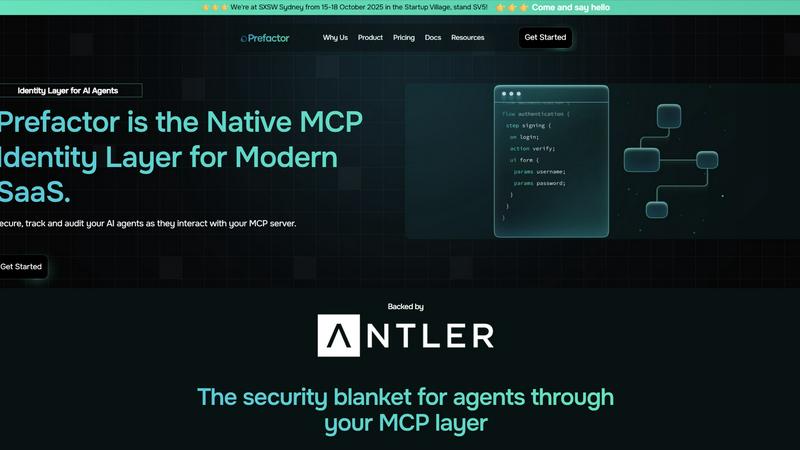
About Prefactor
Prefactor is the essential control plane for AI agents, designed to solve the critical governance gap that emerges when organizations transition autonomous agents from proof-of-concept to full-scale production. It provides a centralized platform for managing identity, access, and auditability across all AI agents within an enterprise. Built specifically for product and engineering teams in regulated industries like banking, healthcare, and mining, Prefactor addresses the core challenges of security, compliance, and operational visibility that typically block safe agent deployment at scale. Its main value proposition is transforming complex, ad-hoc agent authentication and monitoring into a single, elegant layer of trust. By assigning every AI agent a first-class, auditable identity and enabling policy-as-code management, Prefactor aligns security, product, engineering, and compliance teams around one unified source of truth. This allows companies to govern their AI agent fleets faster with shared visibility and control, ensuring agents can operate safely and reliably in environments where "move fast and break things" is not an option.
Features of Prefactor
Real-Time Agent Monitoring
Gain complete operational visibility across your entire agent infrastructure with a centralized control plane dashboard. Track every agent in real-time to see which agents are active, what resources they are accessing, and where failures or anomalies emerge—allowing you to identify and address potential incidents before they cascade into larger problems.
Compliance-Ready Audit Trails
Prefactor's audit logs are designed for regulatory scrutiny. They don't just record technical API events; they translate agent actions into clear business context and language that stakeholders and compliance officers understand. This enables you to generate audit-ready reports in minutes, not weeks, providing clear answers to "what did the agent do and why?"
Identity-First Control
Apply proven human governance principles to your AI agents. With Prefactor, every agent is assigned a unique, first-class identity. Every action is authenticated, and every permission is explicitly scoped. This identity-first foundation is critical for enforcing precise access control and maintaining a secure agent environment.
Enterprise-Grade Integrations & Cost Tracking
Deploy Prefactor in hours, not months, with seamless integration for popular AI agent frameworks like LangChain, CrewAI, and AutoGen, as well as custom builds. Additionally, track agent compute costs across different providers from a single dashboard to identify expensive operational patterns and optimize spending effectively.
Use Cases of Prefactor
Scaling AI Agents in Regulated Finance
A Fortune 500 financial services company can use Prefactor to move AI agent pilots into production by providing the necessary audit trails and real-time visibility demanded by internal compliance and external regulators. This solves the common blocker of not being able to answer critical questions about agent activity and control.
Ensuring Safe Deployment in Healthcare
Healthcare technology firms can deploy AI agents for tasks like patient data analysis or administrative automation while maintaining strict HIPAA and data privacy compliance. Prefactor ensures every agent action is authenticated, logged in business-context terms, and can be immediately halted if necessary, creating a safe governance layer.
Managing Operational Risk in Heavy Industries
Mining or energy companies utilizing autonomous agents for supply chain or safety monitoring require absolute operational reliability. Prefactor provides the emergency kill switches and continuous monitoring needed to manage these high-stakes deployments, ensuring agents operate within strict safety and operational boundaries.
Unifying Multi-Framework Agent Fleets
Product and engineering teams running multiple AI agent pilots using different frameworks (e.g., LangChain and CrewAI) can use Prefactor as a unified control plane. It brings consistency to identity management, access control, and auditing across all agents, regardless of their underlying technology stack.
Frequently Asked Questions
What is an AI Agent Control Plane?
An AI Agent Control Plane is a centralized management layer that provides governance, security, and operational oversight for autonomous AI agents. Think of it like an identity and access management (IAM) system or a Kubernetes control plane, but specifically built for managing the lifecycle, permissions, and auditability of AI agents across an organization.
Who is Prefactor designed for?
Prefactor is primarily built for product and engineering teams within regulated enterprises—such as those in banking, healthcare, insurance, and critical infrastructure—who are running multiple AI agent pilots and need to solve the governance and compliance challenges required to move them into secure, scalable production.
How does Prefactor handle compliance and auditing?
Prefactor creates detailed, immutable audit logs that capture every agent action. Crucially, it translates low-level technical events (like API calls) into high-level business activities that compliance officers and auditors can easily understand. This allows teams to quickly generate reports that demonstrate exactly what agents did and why, satisfying regulatory requirements.
Can Prefactor work with any AI agent framework?
Yes, Prefactor is designed to be framework-agnostic. It offers integrations and SDKs for popular frameworks like LangChain, CrewAI, and AutoGen, and can also integrate with custom-built agent systems. This allows you to manage a heterogeneous fleet of agents from a single, unified dashboard and control plane.
Explore more in this category:
Similar to Prefactor

AI transcription for voice notes, meetings, and audio files in 1,700 languages, with AI summaries and subtitle export and unlimited chat ai usage.

AI sales agent that finds qualified leads, runs outreach, follows up automatically, creates content, and helps book more meetings.

An AI tools directory that turns down money. 146 listings, 20 categories, no sponsored placement and no affiliate ordering.

Get your SaaS tool discovered. Free listing, honest screening, a dofollow link — and no way for anyone to outbid you.

Tools Network is a curated directory of the best AI tools across 25+ categories — from writing and image generation to coding and marketing.


SnapPChart grades a trading chart screenshot A+ to F, with an entry, stop, targets, and risk/reward. Works on stocks, forex, crypto, futures.