
Kompy
Kompy delivers Walmart product data including price history, stock, seller info, and reviews as clean JSON through a REST API and MCP server for.
Visit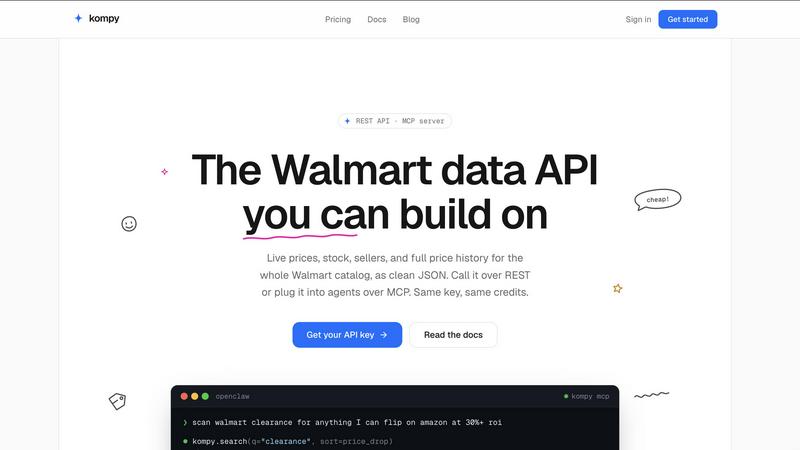
About Kompy
Kompy is a unified ecommerce data API designed to provide structured, reliable, and real-time marketplace data from Walmart without the need to build or maintain web scrapers. It delivers clean, consistent JSON responses for products, search results, barcode lookups, seller offers, customer reviews, and full price and stock history. The platform is built for both human developers and AI agents, offering a REST API that can be called from any programming language and a first-party MCP (Model Context Protocol) server that allows AI agents to query Walmart data directly as callable tools. Kompy targets a wide audience including individual developers building side projects, professional teams integrating marketplace data into their applications, and AI agent developers using tools like Claude Code, OpenClaw, Cursor, or custom stacks. The core value proposition is simplicity and speed: users can get a full product record, search the live catalog, or retrieve historical price trends with a single API call, all without worrying about anti-bot measures, IP bans, or data parsing. Kompy also offers credit-based pricing that scales from hobbyist to production workloads, with Google sign-in for instant API key generation. The platform records Walmart marketplace data around the clock, capturing hourly snapshots of price, stock, and buy-box changes per seller, providing historical data back to day one. This makes it an essential tool for price monitoring, competitive analysis, inventory management, and arbitrage detection.
Features of Kompy
REST API with Clean JSON Responses
Kompy provides a straightforward REST API that returns predictable JSON shapes for every endpoint. No SDK is required, and each response includes a request_id for tracing. Developers can call endpoints for product details, search, history, reviews, and barcode lookup using simple HTTP requests with an API key header. The responses are minimal, structured, and include metadata like latency in milliseconds, making integration seamless across any language or framework.
MCP Server for AI Agents
Kompy ships a first-party MCP server that exposes the same operations as callable tools for AI agents. Agents using Claude Code, OpenClaw, Cursor, or any MCP-compatible stack can directly query Walmart data without writing HTTP code. The agent sees tools like kompy.product, kompy.search, kompy.history, and kompy.reviews, each with deterministic schemas and structured errors. This enables autonomous workflows such as scanning for clearance deals or monitoring price drops.
Full Price and Stock History
Kompy records the Walmart marketplace around the clock, capturing hourly snapshots of price, stock, and buy-box changes for every tracked SKU. The historical data is available per seller and goes back to day one. Users can retrieve price trends over custom date ranges (e.g., 30 days, 12 months) to analyze seasonality, identify optimal buying windows, or track competitor pricing strategies. This feature is unique among Walmart data APIs.
Comprehensive Product and Seller Data
Each API response includes a rich set of product attributes: name, brand, price, currency, stock availability, rating, review count, seller name, and a captured timestamp. The search endpoint supports sorting and filtering by various criteria, and the barcode lookup allows instant product identification. Seller offers are detailed, enabling users to compare multiple sellers for the same product and make informed purchasing or listing decisions.
Use Cases of Kompy
Retail Arbitrage and Flipping
Users can scan Walmart clearance items and compare prices against Amazon or other platforms to identify profitable flips. With Kompy, an AI agent can search for clearance products, retrieve price history to confirm a genuine drop, and calculate ROI based on current market prices. The system can even monitor hourly for new opportunities and alert the user when a profitable flip is detected, as demonstrated by the Samsung TV example with a 34% ROI.
Competitive Price Monitoring
Businesses can track competitor pricing on Walmart in real time. By using the product and history endpoints, they can monitor price changes for specific SKUs, analyze historical trends, and adjust their own pricing strategies accordingly. The per-seller granularity allows them to see which sellers are undercutting the market and respond dynamically, ensuring they remain competitive without manual checking.
AI Agent Automation for Ecommerce
Developers building AI agents for ecommerce tasks can integrate Kompy via MCP to give their agents direct access to Walmart data. Agents can autonomously search for products, check stock, retrieve reviews, and analyze price history to make decisions such as restocking recommendations, price alerts, or product research. This eliminates the need for custom scraping code and reduces latency in agent workflows.
Inventory and Supply Chain Management
Retailers and distributors can use Kompy to monitor stock levels of key products across Walmart sellers. By polling the API at regular intervals, they can detect stockouts or restocks in near real time, allowing them to manage their own inventory pipelines more effectively. The historical data also helps in forecasting demand and identifying seasonal trends.
Frequently Asked Questions
How do I get started with Kompy?
Getting started is simple. Visit the Kompy website and sign in using Google authentication. You will receive an instant API key. You can then start making calls to the REST API using any HTTP client, or configure your AI agent to use the MCP server. Every account starts with free credits, so you can test the API immediately without any upfront payment.
What is the difference between the REST API and the MCP server?
The REST API is a traditional HTTP interface that you can call from any programming language using standard GET and POST requests. The MCP server exposes the same operations as callable tools for AI agents that support the Model Context Protocol, such as Claude Code and OpenClaw. Both use the same API key and credit system, so you can switch between them seamlessly depending on your use case.
What kind of historical data does Kompy provide?
Kompy records hourly snapshots of price, stock, and buy-box changes for every SKU it tracks. The historical data is available per seller and goes back to the day the product was first tracked. You can retrieve this data using the history endpoint with custom date ranges, such as the last 30 days or 12 months. This allows you to analyze price trends, identify patterns, and make data-driven decisions.
How is pricing structured and what are credits?
Kompy uses a credit-based pricing model. Each API call consumes a certain number of credits based on the endpoint and data volume. Plans start at the Hobby tier with 14,000 credits per month for $49.99, the Pro tier with 45,000 credits for $149.99, and the Business tier with 180,000 credits for $499.99. All plans include API access and MCP server access. You can start with free credits to evaluate the service before committing to a plan.
Pricing of Kompy
Kompy offers three tiered pricing plans designed to scale from individual projects to large team deployments. All plans include API access, MCP server access, and email support.
The Hobby plan costs $49.99 per month and provides 14,000 credits per month, suitable for individuals getting started with marketplace data integration. The Pro plan is priced at $149.99 per month with 45,000 credits per month, ideal for professionals and small teams needing higher throughput and priority support. The Business plan costs $499.99 per month and includes 180,000 credits per month, priority support, and custom integrations for large teams with specific requirements.
Every account starts with free credits upon signup, allowing you to test the full functionality without any forced upgrade or dark patterns. Compare all plans and features on the Kompy pricing page to choose the best fit for your workload.
Similar to Kompy

ROIpad grounds SaaS positioning in hard market evidence. Replace creative guesswork with live competitive data to win more high-intent buyers.

Privacy-first, cookieless web analytics that ties your traffic and channels directly to real Stripe revenue.

Online tally counter for tracking attendance, workouts, inventory, visitors, sports scores, habits, and everyday counting tasks.


Research keywords, competitors, backlinks and AI visibility inside Claude or Codex, with findings saved to your SEO dashboard.

Real-time App Store analytics with an AI copilot for portfolio owners.

SnapPChart grades a trading chart screenshot A+ to F, with an entry, stop, targets, and risk/reward. Works on stocks, forex, crypto, futures.