
HiAPI
HiAPI is a unified API for leading AI image, video, and text generation models with persistent storage and callback tracking.
Visit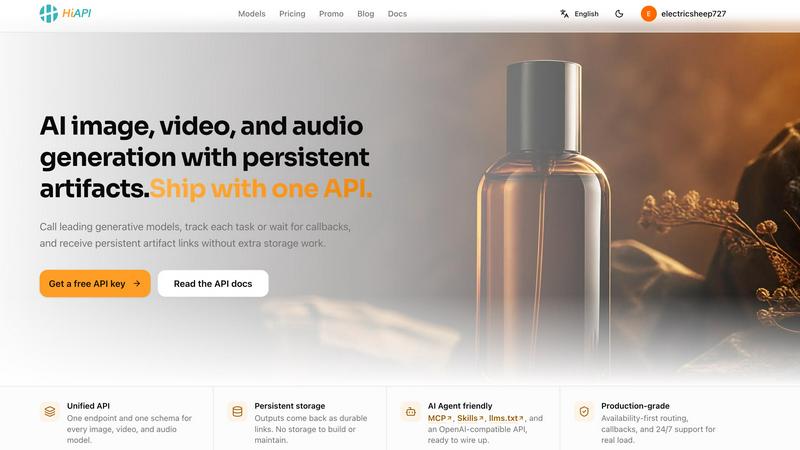
About HiAPI
HiAPI is a developer-first AI API platform designed to simplify access to leading generative AI models for image, video, and audio creation. It provides a unified interface where developers can call multiple top-tier models from providers like OpenAI, ByteDance, Google, Black Forest Labs, and MiniMax using a single API key and one consistent endpoint. The platform eliminates the complexity of managing separate accounts, billing systems, and integration patterns for each AI provider. HiAPI is built for developers building production applications, AI agents, and creative tools that require reliable, scalable access to generative media capabilities. Its core value proposition centers on reducing integration overhead through OpenAI-compatible request formats, unified billing with pay-as-you-go pricing, and persistent artifact storage that removes the need for developers to build and maintain their own storage infrastructure. The platform supports asynchronous task-based workflows with callbacks, idempotency keys for safe retries, and model-specific parameter validation. HiAPI is particularly suited for developers who want to ship generative AI features quickly without getting bogged down in provider-specific SDKs, authentication schemes, or storage management. It also offers agent-friendly integration paths including MCP tools, Skills, and llms.txt for seamless use with AI agents like Claude, Cursor, and Codex. With transparent per-model pricing and free credits for new users, HiAPI lowers the barrier to experimenting with and deploying generative AI in production environments.
Features of HiAPI
Unified API Across Models
HiAPI provides a single endpoint and consistent request schema for every image, video, and audio model on the platform. Developers pass a model name, input parameters, and optional configuration like storage preferences or callback URLs through the same POST /v1/tasks endpoint. This eliminates the need to learn different APIs, authentication methods, or data formats for each AI provider. The platform validates model-specific parameters per request, ensuring that invalid inputs are caught early. Idempotency keys allow safe retries without creating duplicate tasks, making the system robust for production workflows where network failures or timeouts may occur.
Persistent Artifact Storage
Outputs from any generation task come back as durable, persistent links that developers can use immediately in their applications. HiAPI handles all storage infrastructure, meaning teams do not need to build, maintain, or pay for separate file storage systems like S3 buckets or CDN setups. By setting the storage parameter to "persistent" on each task request, developers receive low-cost artifact links that remain accessible indefinitely. This feature is especially valuable for applications that need to serve generated images, videos, or audio to end users without additional latency or complexity from external storage integrations.
Agent-Friendly Integration
HiAPI is designed to work seamlessly with AI agents through multiple integration methods. The platform supports Remote MCP tools for agent-accessible workflows, reusable Skills that provide pre-built instructions for common generation tasks, and an llms.txt file that allows agents to discover and understand the API automatically. Developers can paste the llms.txt prompt into agents like Claude, Cursor, or Codex, and the agent will understand HiAPI models and APIs, then choose the best integration path. This makes HiAPI ideal for building autonomous systems that need to generate media content on demand without human intervention.
Production-Grade Reliability
HiAPI is built for real-world production loads with availability-first routing, automatic callbacks, and 24/7 support. The platform routes requests intelligently to ensure high availability, and the callback mechanism allows developers to receive notifications when tasks complete instead of polling for status. This asynchronous architecture is critical for applications that generate large media files or run batch processing workflows. The platform also supports configurable routes like "beta" or "ext" for accessing experimental or extended model capabilities, giving developers control over which model variants they use.
Use Cases of HiAPI
AI-Powered Content Creation for Marketing Teams
Marketing teams can use HiAPI to generate images, videos, and audio content at scale for social media campaigns, advertisements, and brand materials. With access to models like GPT Image 2 for text-rendered images, FLUX 1.1 Pro for high-fidelity visuals, and MiniMax Music 2.6 for original songs and instrumentals, marketers can create complete multimedia campaigns from a single API. The persistent storage feature ensures that all generated assets are immediately available with durable links that can be embedded in websites, emails, or ad platforms. The unified billing and pay-as-you-go pricing make it cost-effective to experiment with different creative directions before scaling production.
Developer Tools and Prototyping
Developers building creative applications, design tools, or prototyping platforms can integrate HiAPI to add generative AI capabilities without managing multiple provider accounts. The OpenAI-compatible request format means existing codebases that use OpenAI APIs can switch to HiAPI with minimal changes. The task-based lifecycle with idempotency keys is ideal for prototyping tools where users may submit multiple generation requests and need reliable results. The transparent per-model pricing allows developers to estimate costs before integration and offer clear pricing to their own users.
AI Agent Workflows for Autonomous Media Generation
AI agents can use HiAPI to autonomously generate images, videos, and audio as part of larger workflows. For example, an agent tasked with creating a product demo video could use Seedance 2.0 for video generation with native audio, then use MiniMax Music 2.6 to add background music. The MCP tools and Skills integration allow agents to discover and call the appropriate models without manual configuration. The callback mechanism enables agents to continue processing other tasks while waiting for media generation to complete, improving overall workflow efficiency.
E-Commerce and Product Visualization
E-commerce platforms can leverage HiAPI to generate product images, lifestyle shots, and promotional videos using models like Seedream 5.0 Pro for image-to-image editing and GPT Image 2 for text-rendered product labels. The persistent storage feature ensures that all generated product visuals are immediately available for listing pages, advertisements, and social media. The ability to edit existing images with image-to-image workflows allows teams to create multiple product variations from a single base photograph, reducing the need for expensive photoshoots.
Frequently Asked Questions
How do I get started with HiAPI?
Sign up on the HiAPI website to receive a free API key and up to $1 in free credits to test the platform. After signing up, you can immediately start making requests to the POST /v1/tasks endpoint using the provided API key. The platform supports curl, JavaScript, and Python examples in the documentation. For agent integration, you can copy the llms.txt prompt from the HiAPI website and paste it into your agent to enable automatic discovery of models and APIs.
What models are available on HiAPI?
HiAPI provides access to a curated selection of leading generative models. For image generation, models include GPT Image 2 from OpenAI, Nano Banana 2 from Google, FLUX 1.1 Pro from Black Forest Labs, and Seedream 5.0 Pro from ByteDance. For video, Seedance 2.0 from ByteDance is available with cinematic quality and multi-shot consistency. For audio, MiniMax Music 2.6 can generate complete songs from prompts and lyrics. The platform continues to add new models, and developers can explore all available models on the HiAPI website.
How does pricing work on HiAPI?
HiAPI uses transparent pay-as-you-go pricing where each model lists its price upfront. Developers can review each model's cost before integration, allowing for clear cost estimation before production launch. New users receive up to $1 in free credits to test the platform and evaluate different models. There are no fixed monthly plans or hidden fees, and billing is unified across all models accessed through the single API key. This pricing model is designed to be predictable and scalable for both small experiments and large production workloads.
How does the persistent storage feature work?
When you set the storage parameter to "persistent" in your task request, HiAPI stores the generated output and returns a durable artifact link that you can use immediately. You do not need to build or maintain any storage infrastructure, as HiAPI handles all file hosting and delivery. These persistent links are low-cost and remain accessible for as long as you need them. This feature is particularly useful for applications that serve generated media to end users, as it eliminates the complexity and cost of integrating external storage services like S3 or CDNs.
Similar to HiAPI

ImageGPT is an all-in-one AI creative platform for generating, editing and transforming images and videos using AI.

Create release-ready album covers from a prompt or photo. Generate, refine, and export art for singles, EPs, mixtapes, and playlists.

A free browser-based toolkit for creating, cutting, converting, and previewing sprite sheet animations.

Generate and edit production-ready images with GPT Image 2 API using detailed prompts, reference images, clear text rendering, and developer-friendly

Fast AI image generation for photorealistic visuals, bilingual posters, ecommerce content, and social graphics.

Turn flat images into editable transparent layers with AI.

AI enhancer for photos, images, videos, creative effects, and shared asset workflows.
