
Agent to Agent Testing Platform vs Prefactor
Side-by-side comparison to help you choose the right product.

Agent to Agent Testing Platform
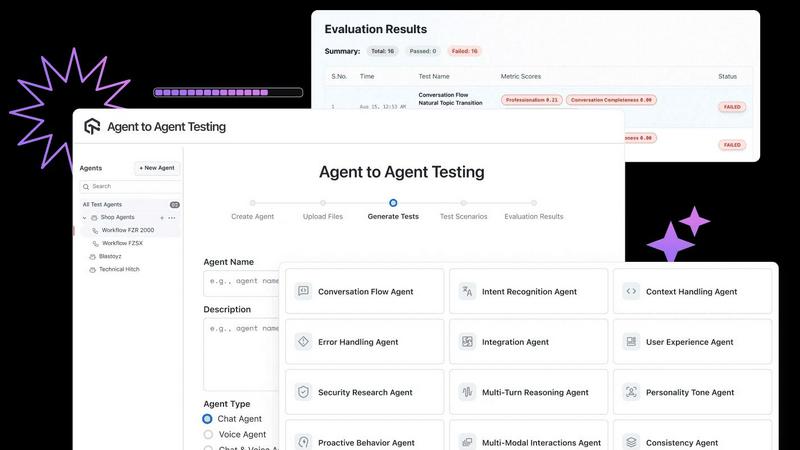
The Agent to Agent Testing Platform evaluates AI agents across multiple modalities to ensure compliance and mitigate.
Last updated: February 26, 2026

Prefactor
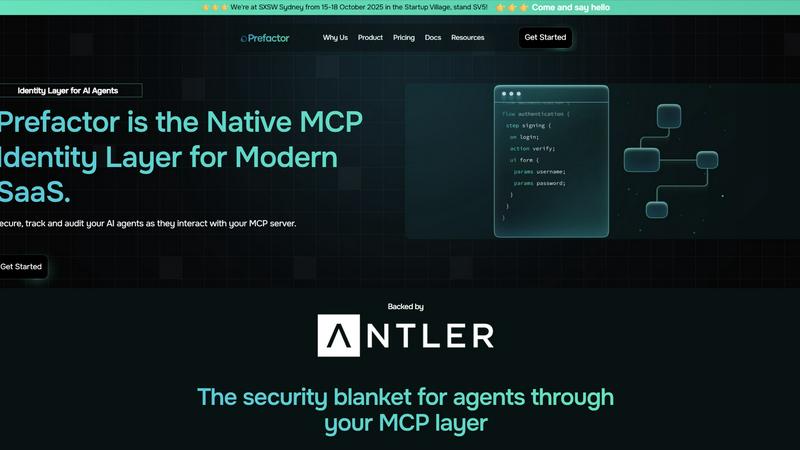
Prefactor is the control plane for governing AI agents at scale with security and compliance.
Last updated: March 1, 2026
Visual Comparison
Agent to Agent Testing Platform
Prefactor
Feature Comparison
Agent to Agent Testing Platform
Automated Scenario Generation
This feature allows for the creation of diverse and dynamic test cases that simulate chat, voice, and phone interactions for AI agents. Automated scenario generation ensures that testing encompasses a wide array of potential user interactions, increasing reliability.
True Multi-Modal Understanding
The platform supports multi-modal testing by allowing users to define detailed requirements and upload various input formats, including images, audio, and video. This capability mirrors real-world scenarios, enabling a comprehensive assessment of AI agents beyond just text interactions.
Autonomous Test Scenario Generation
With access to a library of hundreds of predefined scenarios, users can also create custom scenarios tailored to specific needs. This feature helps assess AI agents across various roles, such as personality tone and intent recognition, ensuring they perform as intended in diverse contexts.
Regression Testing with Risk Scoring
The platform offers end-to-end regression testing with insights into risk scoring, which highlights potential areas of concern. This feature enables testers to prioritize critical issues effectively, optimizing testing efforts and ensuring that the AI agents maintain their quality over time.
Prefactor
Real-Time Agent Monitoring
Gain complete operational visibility across your entire agent infrastructure with a centralized control plane dashboard. Track every agent in real-time to see which agents are active, what resources they are accessing, and where failures or anomalies emerge—allowing you to identify and address potential incidents before they cascade into larger problems.
Compliance-Ready Audit Trails
Prefactor's audit logs are designed for regulatory scrutiny. They don't just record technical API events; they translate agent actions into clear business context and language that stakeholders and compliance officers understand. This enables you to generate audit-ready reports in minutes, not weeks, providing clear answers to "what did the agent do and why?"
Identity-First Control
Apply proven human governance principles to your AI agents. With Prefactor, every agent is assigned a unique, first-class identity. Every action is authenticated, and every permission is explicitly scoped. This identity-first foundation is critical for enforcing precise access control and maintaining a secure agent environment.
Enterprise-Grade Integrations & Cost Tracking
Deploy Prefactor in hours, not months, with seamless integration for popular AI agent frameworks like LangChain, CrewAI, and AutoGen, as well as custom builds. Additionally, track agent compute costs across different providers from a single dashboard to identify expensive operational patterns and optimize spending effectively.
Use Cases
Agent to Agent Testing Platform
Enhancing Chatbot Performance
Enterprises can utilize this platform to systematically evaluate their chatbots across multiple scenarios, ensuring they handle user interactions effectively and meet performance benchmarks related to engagement and satisfaction.
Validating Voice Assistants
Organizations developing voice assistants can leverage the multi-modal understanding feature to test voice interactions. This ensures that the assistant responds accurately and appropriately across various contexts, enhancing user trust and usability.
Testing Hybrid AI Agents
This platform is particularly useful for testing hybrid AI agents that operate across different channels. By simulating diverse user interactions, businesses can ensure consistency in performance regardless of the platform being used.
Ensuring Compliance and Ethical Standards
The Agent to Agent Testing Platform can help organizations assess AI agents for compliance with ethical standards by evaluating metrics such as bias and toxicity. This process is crucial for maintaining brand integrity and trust in AI technologies.
Prefactor
Scaling AI Agents in Regulated Finance
A Fortune 500 financial services company can use Prefactor to move AI agent pilots into production by providing the necessary audit trails and real-time visibility demanded by internal compliance and external regulators. This solves the common blocker of not being able to answer critical questions about agent activity and control.
Ensuring Safe Deployment in Healthcare
Healthcare technology firms can deploy AI agents for tasks like patient data analysis or administrative automation while maintaining strict HIPAA and data privacy compliance. Prefactor ensures every agent action is authenticated, logged in business-context terms, and can be immediately halted if necessary, creating a safe governance layer.
Managing Operational Risk in Heavy Industries
Mining or energy companies utilizing autonomous agents for supply chain or safety monitoring require absolute operational reliability. Prefactor provides the emergency kill switches and continuous monitoring needed to manage these high-stakes deployments, ensuring agents operate within strict safety and operational boundaries.
Unifying Multi-Framework Agent Fleets
Product and engineering teams running multiple AI agent pilots using different frameworks (e.g., LangChain and CrewAI) can use Prefactor as a unified control plane. It brings consistency to identity management, access control, and auditing across all agents, regardless of their underlying technology stack.
Overview
About Agent to Agent Testing Platform
Agent to Agent Testing Platform is a pioneering AI-native quality and assurance framework tailored specifically for validating the behavior of AI agents in real-world scenarios. As AI systems grow more autonomous and complex, traditional quality assurance methods designed for static software become inadequate. This platform transcends basic prompt-level evaluations, providing comprehensive assessments of multi-turn conversations across various mediums, including chat, voice, and phone interactions. It is ideal for enterprises aiming to ensure their AI agents are reliable and effective before deployment. The platform facilitates detailed analysis of critical metrics such as bias, toxicity, and hallucination, enabling organizations to mitigate risks and enhance user experience.
About Prefactor
Prefactor is the essential control plane for AI agents, designed to solve the critical governance gap that emerges when organizations transition autonomous agents from proof-of-concept to full-scale production. It provides a centralized platform for managing identity, access, and auditability across all AI agents within an enterprise. Built specifically for product and engineering teams in regulated industries like banking, healthcare, and mining, Prefactor addresses the core challenges of security, compliance, and operational visibility that typically block safe agent deployment at scale. Its main value proposition is transforming complex, ad-hoc agent authentication and monitoring into a single, elegant layer of trust. By assigning every AI agent a first-class, auditable identity and enabling policy-as-code management, Prefactor aligns security, product, engineering, and compliance teams around one unified source of truth. This allows companies to govern their AI agent fleets faster with shared visibility and control, ensuring agents can operate safely and reliably in environments where "move fast and break things" is not an option.
Frequently Asked Questions
Agent to Agent Testing Platform FAQ
What types of AI agents can be tested with this platform?
The Agent to Agent Testing Platform supports various AI agents, including chatbots, voice assistants, and phone caller agents, across multiple interaction scenarios.
How does automated scenario generation work?
Automated scenario generation utilizes algorithms to create diverse test cases that simulate real-world interactions, ensuring a comprehensive assessment of AI agent performance in various situations.
Can I integrate the platform with existing CI/CD tools?
Yes, the platform seamlessly integrates with existing CI/CD tools, allowing for large-scale cloud execution and efficient management of test scenarios.
What metrics can be measured during testing?
Key metrics that can be evaluated include bias, toxicity, hallucination, effectiveness, accuracy, empathy, and professionalism, providing a holistic view of AI agent performance.
Prefactor FAQ
What is an AI Agent Control Plane?
An AI Agent Control Plane is a centralized management layer that provides governance, security, and operational oversight for autonomous AI agents. Think of it like an identity and access management (IAM) system or a Kubernetes control plane, but specifically built for managing the lifecycle, permissions, and auditability of AI agents across an organization.
Who is Prefactor designed for?
Prefactor is primarily built for product and engineering teams within regulated enterprises—such as those in banking, healthcare, insurance, and critical infrastructure—who are running multiple AI agent pilots and need to solve the governance and compliance challenges required to move them into secure, scalable production.
How does Prefactor handle compliance and auditing?
Prefactor creates detailed, immutable audit logs that capture every agent action. Crucially, it translates low-level technical events (like API calls) into high-level business activities that compliance officers and auditors can easily understand. This allows teams to quickly generate reports that demonstrate exactly what agents did and why, satisfying regulatory requirements.
Can Prefactor work with any AI agent framework?
Yes, Prefactor is designed to be framework-agnostic. It offers integrations and SDKs for popular frameworks like LangChain, CrewAI, and AutoGen, and can also integrate with custom-built agent systems. This allows you to manage a heterogeneous fleet of agents from a single, unified dashboard and control plane.
Alternatives
Agent to Agent Testing Platform Alternatives
Agent to Agent Testing Platform is a pioneering AI-native quality assurance framework that validates the behavior of AI agents across various communication channels, including chat, voice, and phone. This innovative platform is essential in a landscape where AI systems are increasingly autonomous and complex, making traditional quality assurance models inadequate. Users often seek alternatives due to factors such as pricing, specific feature sets, or particular platform requirements that better align with their business needs. When considering alternatives, it is crucial to evaluate the specific functionalities offered, the scalability of the solution, and the overall user experience. Look for platforms that provide comprehensive testing capabilities, ensuring thorough validation of AI agent interactions in real-world scenarios. Prioritizing flexibility and adaptability to suit unique operational demands will also be essential in your decision-making process.
Prefactor Alternatives
Prefactor is a specialized control plane platform within the AI governance and security category. It is designed to provide centralized identity, access, and audit management for AI agents, enabling secure and compliant deployment at scale in regulated industries. Users may explore alternatives for various reasons, including budget constraints, specific feature requirements not covered, or a need for a solution that integrates with a different technology stack or a broader platform. The evaluation process often involves comparing core capabilities and total cost of ownership. When selecting an alternative, key considerations should include robust agent identity and authentication, comprehensive audit logging for compliance, real-time operational visibility, and the ability to enforce security policies programmatically. The solution must align with your organization's specific regulatory requirements and technical environment.