
PoYo API vs Project20x
Side-by-side comparison to help you choose the right product.

PoYo API
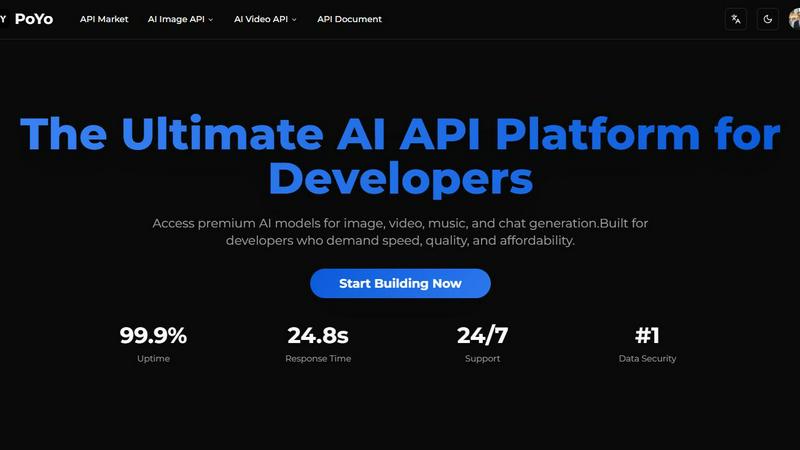
PoYo API gives developers unified access to premium AI models for image, video, music, and chat generation.
Last updated: February 28, 2026

Project20x
Project20x delivers AI governance solutions that ensure compliance and effectiveness for today's evolving policy needs.
Last updated: March 4, 2026
Visual Comparison
PoYo API
Project20x
Feature Comparison
PoYo API
Unified Multi-Model API Access
PoYo API provides streamlined access to a comprehensive library of over 500 premium AI models through a single, consistent API endpoint and one universal API key. This eliminates the complexity of integrating and managing separate connections, documentation, and authentication for dozens of individual AI service providers. Developers can seamlessly switch between cutting-edge image, video, music, and chat models without restructuring their codebase, dramatically accelerating development cycles and simplifying ongoing maintenance.
Credit-Based, Subscription-Free Pricing
The platform operates on a transparent, pay-as-you-go credit system that requires no monthly subscriptions or long-term commitments. Users purchase credits that never expire and are consumed based on actual API usage. This model offers unparalleled cost predictability and flexibility, allowing startups to manage budgets tightly and enterprises to scale their AI operations up or down without being locked into rigid, recurring plans. It ensures you only pay for the generations you successfully complete.
Enterprise-Grade Reliability & Performance
Built for production environments, PoYo API guarantees 99.9% uptime and features ultra-low latency response times, often under 50ms. The infrastructure is designed to handle massive concurrent requests efficiently. For long-running tasks like video generation, the async API with webhook support provides real-time callbacks upon completion. This focus on reliability, speed, and high concurrency ensures that applications remain responsive and scalable under heavy user load.
Developer-Centric Tools & Security
PoYo API is built with a deep understanding of developer needs. It offers a simple two-endpoint integration for most tasks, a free playground for testing all models without a credit card, and a dashboard with manual retry capabilities for failed tasks. Security is paramount: API keys are stored with encryption following a zero-knowledge architecture, and full audit logging is available for compliance. Coupled with 24/7 monitoring and dedicated technical support, it provides a secure and supportive environment for development.
Project20x
Governance Layer
The Governance Layer employs a sophisticated ten-step AI methodology designed to assist lawmakers in developing sound policies. By analyzing legislative texts, it ensures clarity and identifies potential conflicts, enabling lawmakers to create more effective and understandable regulations.
Management Layer
The Management Layer is responsible for turning approved policies into functional code. By implementing "Rules as Code," it creates efficient automated workflows that significantly enhance operational efficiency within government agencies, reducing manual processes and errors.
Interface Layer
The Interface Layer provides citizens with round-the-clock access to AI agents trained specifically on the codified policies. This feature streamlines public service interactions, allowing citizens to obtain information and services quickly and effectively, thereby improving user experience.
Transparency and Accountability
Project20x is committed to ensuring transparency and accountability in governmental operations. All activities conducted through the platform are traceable and quantifiable, with rigorous human oversight in place to maintain the integrity of public service delivery and to instill public trust.
Use Cases
PoYo API
Marketing & Content Creation Automation
Businesses can automate the generation of high-quality marketing assets at scale. This includes creating product images for e-commerce sites, generating promotional video clips for social media campaigns, and producing custom music for advertisements or branded content. By integrating PoYo API, marketing teams can produce diverse, on-brand visual and audio content programmatically, significantly reducing production time and costs while maintaining creative flexibility.
AI-Powered Application Development
Developers can build and power next-generation applications that have AI at their core. This includes applications like intelligent chatbots using the latest conversational models (Claude, GPT-5), creative tools for generating artwork or music, and platforms for personalized video creation. PoYo API provides the reliable, scalable backend AI engine, allowing developers to focus on building unique user experiences and front-end interfaces without managing complex AI infrastructure.
Media & Entertainment Production
Studios, indie creators, and game developers can leverage the API for various production tasks. This encompasses storyboarding with generated images, creating concept art, composing background scores or sound effects using the music API, and even prototyping visual effects with AI-generated video sequences. It serves as a powerful tool for ideation, pre-visualization, and adding AI-enhanced elements to creative projects.
Research & Development Prototyping
Researchers and product teams can rapidly prototype new ideas that involve generative AI. The free playground and flexible credit system allow for extensive experimentation with different models (image, video, chat, music) to test hypotheses, validate concepts, and gather data on AI outputs for specific use cases. This accelerates the R&D phase by providing immediate access to a wide array of state-of-the-art models without significant upfront investment.
Project20x
Legislative Process Enhancement
Project20x can enhance the legislative process by providing lawmakers with tools to draft clearer and more effective policies. By analyzing existing texts and suggesting modifications, the platform simplifies the complexities involved in policymaking.
Public Engagement Optimization
Government agencies can use Project20x to optimize public engagement by allowing citizens to interact with AI agents. This makes it easier for the public to understand policies and access services, fostering a more engaged citizenry.
Workflow Automation
Agencies can leverage the Management Layer of Project20x to automate workflows that are traditionally manual. This not only saves time and resources but also minimizes errors, leading to more efficient service delivery.
Training and Development
Project20x can be utilized for training governmental staff. By familiarizing them with the AI-driven processes and tools, agencies can ensure that their personnel are equipped to handle modern challenges in public administration effectively.
Overview
About PoYo API
PoYo API is the ultimate, centralized platform engineered for developers and businesses seeking to integrate cutting-edge generative AI into their applications. It functions as a single, unified gateway to a vast library of over 500 premium AI models spanning image, video, music, and chat generation. The platform directly addresses the core pain points of AI integration: complexity, cost unpredictability, and vendor management fatigue. By consolidating access to top-tier models like Sora-2, Nano Banana Pro, GPT-4o, and Veo3.1 under one consistent API, PoYo API eliminates the need to juggle multiple API keys, disparate documentation, and varying billing systems. Its core value proposition is delivering an enterprise-grade combination of speed, quality, and affordability. Developers benefit from ultra-low latency response times, guaranteed 99.9% uptime, and a flexible, credit-based pricing model with no recurring subscriptions. This allows teams to build and scale next-generation AI applications—from dynamic marketing content generators to intelligent chatbots and music composition tools—with predictable costs and minimal operational overhead, all backed by 24/7 technical support.
About Project20x
Project20x is a cutting-edge AI-driven platform designed specifically to transform governmental operations by simplifying complex regulatory frameworks into user-friendly, actionable digital processes. Targeted at government agencies, lawmakers, and citizens, Project20x serves as a crucial bridge between policy creation and public engagement, enhancing the overall efficiency and accessibility of governmental services. The platform operates through three distinct layers: the Governance Layer, which utilizes a ten-step AI methodology to assist lawmakers in crafting clear and effective policies by analyzing legislative texts for clarity and identifying potential conflicts; the Management Layer, which converts approved policies into operational code via "Rules as Code," streamlining automated workflows; and the Interface Layer, which provides citizens with 24/7 access to AI agents trained on these codified policies, thereby simplifying interactions with public services. Committed to transparency, accountability, and security, Project20x ensures that all governmental activities remain traceable, quantifiable, and subject to rigorous human oversight, ultimately fostering a more engaged and informed citizenry.
Frequently Asked Questions
PoYo API FAQ
How does the credit-based pricing work?
Credits are a universal currency on PoYo API. You purchase a pack of credits upfront, and different AI models consume a specific number of credits per generation task (e.g., an image generation may cost 1 credit, while a high-resolution video may cost 50). The key advantages are that credits never expire, there are no recurring subscription fees, and you only pay for what you use. This provides full cost control and predictability, scaling directly with your application's usage.
What happens if an AI generation task fails?
PoYo API is designed with developer control in mind. If a generation task fails due to a model error or timeout, you are not charged for the attempt. The platform provides mechanisms to handle this gracefully: you can set up webhooks to receive failure notifications, and the user dashboard includes a manual retry function, giving you full visibility and control over your task queue without losing credits.
Is there a way to test the models before integrating?
Yes. PoYo API offers a completely free playground accessible on each model's page. You can experiment with all available image, video, music, and chat models, fine-tune generation parameters (like prompts, dimensions, and styles), and see the outputs in real-time. This allows you to evaluate model quality, debug prompts, and validate API behavior without signing up for a paid plan or spending any credits.
How does PoYo API ensure security and privacy?
Security is a top priority. Your API keys are encrypted using industry-standard protocols and stored following a zero-knowledge architecture, meaning even PoYo's internal systems cannot access them in plaintext. The platform provides full audit logging for all API activities, which is essential for compliance and security monitoring. Furthermore, for sensitive operations, you maintain control over your data and workflows through the secure dashboard and API.
Project20x FAQ
What types of government agencies can benefit from Project20x?
Project20x is designed for a wide range of government agencies, including but not limited to legislative bodies, regulatory agencies, and public service departments. Its versatility makes it suitable for various governmental functions.
How does Project20x ensure data security?
Project20x prioritizes security by implementing strict data protection measures. All user interactions and data processing activities are conducted under rigorous security protocols to safeguard sensitive information from unauthorized access.
Can citizens directly interact with Project20x?
Yes, citizens can interact directly with Project20x through the Interface Layer. They can access AI agents trained on codified policies, making it easier for them to obtain information and services at any time.
What is the significance of "Rules as Code" in Project20x?
"Rules as Code" is a critical feature of Project20x that converts policies into executable code. This approach enhances clarity and reduces the risk of misinterpretation, ensuring that policies are implemented accurately and efficiently across government systems.
Alternatives
PoYo API Alternatives
PoYo API is a centralized platform in the AI Assistants category, providing developers with unified access to over 500 premium AI models for generating images, videos, music, and chat. It simplifies building AI-powered applications by aggregating top models under a single API key and consistent interface. Users may explore alternatives for various reasons, such as seeking different pricing models, requiring specific niche models not available in a broad library, or needing a platform with a different focus, like open-source model hosting or specialized tooling for a single modality like video. When evaluating alternatives, key considerations include the range and quality of supported AI models, the clarity and scalability of the pricing structure, the reliability and speed of the API infrastructure, and the level of developer support and documentation provided. The best choice depends on your project's specific technical and budgetary requirements.
Project20x Alternatives
Project20x is a cutting-edge AI governance platform designed to enhance governmental operations by transforming complex regulatory frameworks into accessible digital processes. By targeting government agencies, lawmakers, and citizens, it addresses the need for effective policy creation and public engagement. As an AI-driven solution, Project20x falls into the category of AI Assistants tailored specifically for governance. Users often seek alternatives to Project20x for various reasons, including pricing, specific features, or unique platform requirements. When choosing an alternative, it's essential to evaluate factors such as ease of use, integration capabilities, the depth of AI functionalities, and the level of customer support offered by the provider. Ensuring that these alternatives align with organizational goals and compliance needs is also crucial for making an informed decision.