
LLMWise vs PoYo API
Side-by-side comparison to help you choose the right product.

LLMWise
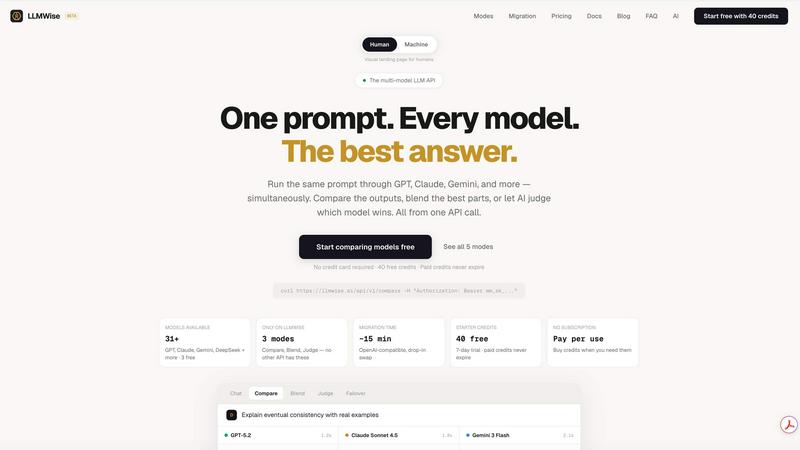
LLMWise offers a single API to access and compare multiple AI models, charging only for usage with no subscriptions.
Last updated: February 26, 2026

PoYo API
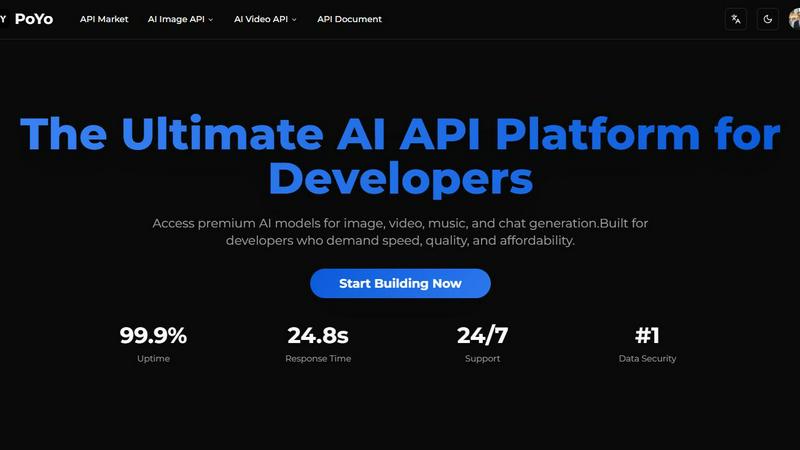
PoYo API gives developers unified access to premium AI models for image, video, music, and chat generation.
Last updated: February 28, 2026
Visual Comparison
LLMWise
PoYo API
Feature Comparison
LLMWise
Smart Routing
LLMWise's smart routing capability intelligently directs prompts to the optimal model based on task requirements. For instance, it routes code-related queries to GPT, creative writing prompts to Claude, and translation tasks to Gemini, ensuring that users receive the best possible responses tailored to their needs.
Compare & Blend
The compare and blend feature allows users to run prompts across multiple models simultaneously. This functionality not only provides side-by-side comparisons of responses but also offers a blending option that synthesizes the most effective parts of various outputs into a single, stronger answer, enhancing the overall quality of results.
Always Resilient
LLMWise includes a built-in circuit-breaker failover mechanism that ensures uninterrupted service. If a primary model experiences downtime, the system automatically reroutes requests to backup models, guaranteeing that applications remain functional and reliable even during outages.
Test & Optimize
With comprehensive benchmarking suites and batch testing capabilities, LLMWise enables users to optimize their AI interactions. It offers various policies for speed, cost, and reliability, along with automated regression checks to ensure consistent performance, making it an invaluable tool for developers focused on refining their applications.
PoYo API
Unified Multi-Model API Access
PoYo API provides streamlined access to a comprehensive library of over 500 premium AI models through a single, consistent API endpoint and one universal API key. This eliminates the complexity of integrating and managing separate connections, documentation, and authentication for dozens of individual AI service providers. Developers can seamlessly switch between cutting-edge image, video, music, and chat models without restructuring their codebase, dramatically accelerating development cycles and simplifying ongoing maintenance.
Credit-Based, Subscription-Free Pricing
The platform operates on a transparent, pay-as-you-go credit system that requires no monthly subscriptions or long-term commitments. Users purchase credits that never expire and are consumed based on actual API usage. This model offers unparalleled cost predictability and flexibility, allowing startups to manage budgets tightly and enterprises to scale their AI operations up or down without being locked into rigid, recurring plans. It ensures you only pay for the generations you successfully complete.
Enterprise-Grade Reliability & Performance
Built for production environments, PoYo API guarantees 99.9% uptime and features ultra-low latency response times, often under 50ms. The infrastructure is designed to handle massive concurrent requests efficiently. For long-running tasks like video generation, the async API with webhook support provides real-time callbacks upon completion. This focus on reliability, speed, and high concurrency ensures that applications remain responsive and scalable under heavy user load.
Developer-Centric Tools & Security
PoYo API is built with a deep understanding of developer needs. It offers a simple two-endpoint integration for most tasks, a free playground for testing all models without a credit card, and a dashboard with manual retry capabilities for failed tasks. Security is paramount: API keys are stored with encryption following a zero-knowledge architecture, and full audit logging is available for compliance. Coupled with 24/7 monitoring and dedicated technical support, it provides a secure and supportive environment for development.
Use Cases
LLMWise
Efficient AI Integration
Developers can swiftly integrate multiple AI models into their applications without the need for complex setups or multiple API keys. LLMWise provides a single API key for accessing various models, saving time and reducing overhead.
Enhanced Debugging
For teams working on software development, the compare mode serves as a powerful debugging tool. By running the same prompt across different models, developers can quickly identify which model handles specific edge cases better, streamlining the debugging process and improving code quality.
Cost-Effective AI Solutions
Startups and small businesses can leverage LLMWise to minimize costs associated with multiple AI subscriptions. By using LLMWise’s pay-as-you-go model, teams can reduce expenses significantly while still accessing high-quality AI services tailored to their needs.
Versatile Application Development
LLMWise is ideal for creating applications that require diverse AI functionalities, such as chatbots, content creation tools, and multi-language platforms. The ability to blend outputs and switch between models easily allows developers to build versatile applications that cater to a wide range of user needs.
PoYo API
Marketing & Content Creation Automation
Businesses can automate the generation of high-quality marketing assets at scale. This includes creating product images for e-commerce sites, generating promotional video clips for social media campaigns, and producing custom music for advertisements or branded content. By integrating PoYo API, marketing teams can produce diverse, on-brand visual and audio content programmatically, significantly reducing production time and costs while maintaining creative flexibility.
AI-Powered Application Development
Developers can build and power next-generation applications that have AI at their core. This includes applications like intelligent chatbots using the latest conversational models (Claude, GPT-5), creative tools for generating artwork or music, and platforms for personalized video creation. PoYo API provides the reliable, scalable backend AI engine, allowing developers to focus on building unique user experiences and front-end interfaces without managing complex AI infrastructure.
Media & Entertainment Production
Studios, indie creators, and game developers can leverage the API for various production tasks. This encompasses storyboarding with generated images, creating concept art, composing background scores or sound effects using the music API, and even prototyping visual effects with AI-generated video sequences. It serves as a powerful tool for ideation, pre-visualization, and adding AI-enhanced elements to creative projects.
Research & Development Prototyping
Researchers and product teams can rapidly prototype new ideas that involve generative AI. The free playground and flexible credit system allow for extensive experimentation with different models (image, video, chat, music) to test hypotheses, validate concepts, and gather data on AI outputs for specific use cases. This accelerates the R&D phase by providing immediate access to a wide array of state-of-the-art models without significant upfront investment.
Overview
About LLMWise
LLMWise is a sophisticated API management tool designed to streamline access to the best language models from various providers. By integrating multiple leading LLMs—including OpenAI's GPT, Claude from Anthropic, Google's Gemini, Meta's offerings, xAI, and DeepSeek—into one platform, LLMWise empowers developers to optimize their AI usage without the hassle of managing multiple subscriptions. Its intelligent routing system ensures that each prompt is directed to the most suitable model, enhancing performance across diverse tasks. Whether you are a developer looking for efficient AI solutions or a startup seeking cost-effective strategies, LLMWise provides a robust framework that simplifies interactions with AI models, allowing users to focus on innovation rather than complexity.
About PoYo API
PoYo API is the ultimate, centralized platform engineered for developers and businesses seeking to integrate cutting-edge generative AI into their applications. It functions as a single, unified gateway to a vast library of over 500 premium AI models spanning image, video, music, and chat generation. The platform directly addresses the core pain points of AI integration: complexity, cost unpredictability, and vendor management fatigue. By consolidating access to top-tier models like Sora-2, Nano Banana Pro, GPT-4o, and Veo3.1 under one consistent API, PoYo API eliminates the need to juggle multiple API keys, disparate documentation, and varying billing systems. Its core value proposition is delivering an enterprise-grade combination of speed, quality, and affordability. Developers benefit from ultra-low latency response times, guaranteed 99.9% uptime, and a flexible, credit-based pricing model with no recurring subscriptions. This allows teams to build and scale next-generation AI applications—from dynamic marketing content generators to intelligent chatbots and music composition tools—with predictable costs and minimal operational overhead, all backed by 24/7 technical support.
Frequently Asked Questions
LLMWise FAQ
What is LLMWise?
LLMWise is an API management tool that consolidates access to multiple language models from various providers, enabling users to optimize AI interactions through intelligent routing and orchestration.
How does Smart Routing work?
Smart Routing analyzes the nature of each prompt and directs it to the most appropriate language model. This ensures that users receive the best responses based on the specific requirements of their queries.
Can I use my existing API keys with LLMWise?
Yes, LLMWise supports Bring Your Own Key (BYOK), allowing users to integrate their existing API keys. This feature provides flexibility in managing costs while still benefiting from LLMWise’s intelligent routing and failover capabilities.
Is there a free trial available?
LLMWise offers a free trial that includes 20 credits, allowing users to explore its features without needing a credit card. Additionally, there are 30 free models available for long-term use, enabling continuous testing and fallback options.
PoYo API FAQ
How does the credit-based pricing work?
Credits are a universal currency on PoYo API. You purchase a pack of credits upfront, and different AI models consume a specific number of credits per generation task (e.g., an image generation may cost 1 credit, while a high-resolution video may cost 50). The key advantages are that credits never expire, there are no recurring subscription fees, and you only pay for what you use. This provides full cost control and predictability, scaling directly with your application's usage.
What happens if an AI generation task fails?
PoYo API is designed with developer control in mind. If a generation task fails due to a model error or timeout, you are not charged for the attempt. The platform provides mechanisms to handle this gracefully: you can set up webhooks to receive failure notifications, and the user dashboard includes a manual retry function, giving you full visibility and control over your task queue without losing credits.
Is there a way to test the models before integrating?
Yes. PoYo API offers a completely free playground accessible on each model's page. You can experiment with all available image, video, music, and chat models, fine-tune generation parameters (like prompts, dimensions, and styles), and see the outputs in real-time. This allows you to evaluate model quality, debug prompts, and validate API behavior without signing up for a paid plan or spending any credits.
How does PoYo API ensure security and privacy?
Security is a top priority. Your API keys are encrypted using industry-standard protocols and stored following a zero-knowledge architecture, meaning even PoYo's internal systems cannot access them in plaintext. The platform provides full audit logging for all API activities, which is essential for compliance and security monitoring. Furthermore, for sensitive operations, you maintain control over your data and workflows through the secure dashboard and API.
Alternatives
LLMWise Alternatives
LLMWise is an innovative API solution designed to simplify access to various language models, including GPT, Claude, Gemini, and more. It falls under the category of AI Assistants, offering intelligent routing that ensures users can leverage the best model for their specific needs. Users often seek alternatives to LLMWise for reasons such as pricing flexibility, feature sets that align better with their use cases, or specific platform compatibility requirements. When selecting an alternative, it is crucial to consider factors like ease of integration, the range of supported models, reliability, and overall cost structure. --- [{"question": "What is LLMWise?", "answer": "LLMWise is a unified API that provides access to multiple language models, intelligently routing prompts to the most suitable one."},{"question": "Who is LLMWise for?", "answer": "LLMWise is designed for developers who require efficient access to various AI models without the complexity of managing multiple providers."},{"question": "Is LLMWise free?", "answer": "LLMWise operates on a pay-per-use model, allowing users to pay for what they consume without any subscription fees."}]
PoYo API Alternatives
PoYo API is a centralized platform in the AI Assistants category, providing developers with unified access to over 500 premium AI models for generating images, videos, music, and chat. It simplifies building AI-powered applications by aggregating top models under a single API key and consistent interface. Users may explore alternatives for various reasons, such as seeking different pricing models, requiring specific niche models not available in a broad library, or needing a platform with a different focus, like open-source model hosting or specialized tooling for a single modality like video. When evaluating alternatives, key considerations include the range and quality of supported AI models, the clarity and scalability of the pricing structure, the reliability and speed of the API infrastructure, and the level of developer support and documentation provided. The best choice depends on your project's specific technical and budgetary requirements.