
AdaptlyPost vs PoYo API
Side-by-side comparison to help you choose the right product.

AdaptlyPost
AdaptlyPost simplifies social media management by allowing you to create, schedule, and publish content across all platforms from one dashboard.
Last updated: March 11, 2026

PoYo API
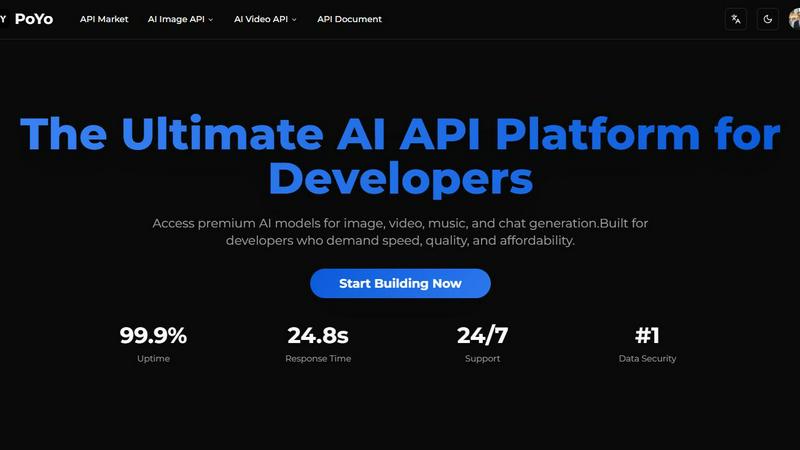
PoYo API gives developers unified access to premium AI models for image, video, music, and chat generation.
Last updated: February 28, 2026
Visual Comparison
AdaptlyPost

PoYo API
Feature Comparison
AdaptlyPost
Smart Scheduling
The Smart Scheduling feature empowers users to plan and publish content seamlessly across all their social media platforms. With just a single click, you can share your content on multiple networks, ensuring that each post is optimized for its respective platform. This automation minimizes the risk of posting errors and saves valuable time.
Multi-Platform Posting
AdaptlyPost allows you to create a single post and distribute it to various social media channels simultaneously. This feature eliminates the need to manually adjust content for each platform’s unique requirements, enabling users to maintain a consistent brand voice while maximizing reach and engagement.
AI Caption Copilot
The AI Caption Copilot assists users in creating compelling captions that resonate with the specific tone and audience of each social media platform. By leveraging AI technology, users can generate caption ideas, rewrite existing text for different formats, and incorporate trending hashtags, making the content creation process more efficient and engaging.
AI Image Studio
With the AI Image Studio, users can generate eye-catching visuals in seconds. Simply describe your vision, and the AI will create stunning images that align with your brand's identity. This feature is ideal for marketers and content creators looking to enhance their visual storytelling without needing extensive design skills.
PoYo API
Unified Multi-Model API Access
PoYo API provides streamlined access to a comprehensive library of over 500 premium AI models through a single, consistent API endpoint and one universal API key. This eliminates the complexity of integrating and managing separate connections, documentation, and authentication for dozens of individual AI service providers. Developers can seamlessly switch between cutting-edge image, video, music, and chat models without restructuring their codebase, dramatically accelerating development cycles and simplifying ongoing maintenance.
Credit-Based, Subscription-Free Pricing
The platform operates on a transparent, pay-as-you-go credit system that requires no monthly subscriptions or long-term commitments. Users purchase credits that never expire and are consumed based on actual API usage. This model offers unparalleled cost predictability and flexibility, allowing startups to manage budgets tightly and enterprises to scale their AI operations up or down without being locked into rigid, recurring plans. It ensures you only pay for the generations you successfully complete.
Enterprise-Grade Reliability & Performance
Built for production environments, PoYo API guarantees 99.9% uptime and features ultra-low latency response times, often under 50ms. The infrastructure is designed to handle massive concurrent requests efficiently. For long-running tasks like video generation, the async API with webhook support provides real-time callbacks upon completion. This focus on reliability, speed, and high concurrency ensures that applications remain responsive and scalable under heavy user load.
Developer-Centric Tools & Security
PoYo API is built with a deep understanding of developer needs. It offers a simple two-endpoint integration for most tasks, a free playground for testing all models without a credit card, and a dashboard with manual retry capabilities for failed tasks. Security is paramount: API keys are stored with encryption following a zero-knowledge architecture, and full audit logging is available for compliance. Coupled with 24/7 monitoring and dedicated technical support, it provides a secure and supportive environment for development.
Use Cases
AdaptlyPost
Social Media Managers
Social media managers can leverage AdaptlyPost to streamline their workflow by planning, scheduling, and publishing posts across various platforms from a single dashboard. This efficiency allows them to focus on strategy and engagement rather than getting bogged down in administrative tasks.
Small Businesses
Small business owners can use AdaptlyPost to manage their social media presence effectively without the need for a dedicated marketing team. By utilizing the platform's features, they can reach their target audience, promote their products, and build brand awareness efficiently.
Content Creators
Content creators can benefit from AdaptlyPost by simplifying the process of sharing their work across multiple channels. Whether they are launching a new project or sharing updates, the platform ensures that their content is presented consistently and professionally.
Marketing Agencies
Marketing agencies can utilize AdaptlyPost to manage multiple client accounts simultaneously. The platform's robust features allow agencies to collaborate with team members, schedule posts, and analyze engagement metrics, enhancing their overall service delivery to clients.
PoYo API
Marketing & Content Creation Automation
Businesses can automate the generation of high-quality marketing assets at scale. This includes creating product images for e-commerce sites, generating promotional video clips for social media campaigns, and producing custom music for advertisements or branded content. By integrating PoYo API, marketing teams can produce diverse, on-brand visual and audio content programmatically, significantly reducing production time and costs while maintaining creative flexibility.
AI-Powered Application Development
Developers can build and power next-generation applications that have AI at their core. This includes applications like intelligent chatbots using the latest conversational models (Claude, GPT-5), creative tools for generating artwork or music, and platforms for personalized video creation. PoYo API provides the reliable, scalable backend AI engine, allowing developers to focus on building unique user experiences and front-end interfaces without managing complex AI infrastructure.
Media & Entertainment Production
Studios, indie creators, and game developers can leverage the API for various production tasks. This encompasses storyboarding with generated images, creating concept art, composing background scores or sound effects using the music API, and even prototyping visual effects with AI-generated video sequences. It serves as a powerful tool for ideation, pre-visualization, and adding AI-enhanced elements to creative projects.
Research & Development Prototyping
Researchers and product teams can rapidly prototype new ideas that involve generative AI. The free playground and flexible credit system allow for extensive experimentation with different models (image, video, chat, music) to test hypotheses, validate concepts, and gather data on AI outputs for specific use cases. This accelerates the R&D phase by providing immediate access to a wide array of state-of-the-art models without significant upfront investment.
Overview
About AdaptlyPost
AdaptlyPost is a powerful all-in-one social media management dashboard designed to simplify and streamline the process of creating, scheduling, and publishing content across multiple platforms including X, Instagram, TikTok, YouTube, and more. This innovative tool is tailored for individuals, businesses, and agencies looking to enhance their social media presence without the hassle of juggling multiple applications. The platform features an intuitive user interface that allows users to create engaging posts once and distribute them across various channels effortlessly. By integrating a robust AI Co-pilot, AdaptlyPost not only generates platform-specific captions but also aids in crafting visually appealing content through the AI Image Studio. Users can manage their content pipeline effectively, ensuring that all drafts and scheduled posts are visible in one unified view, ultimately saving hours each week.
About PoYo API
PoYo API is the ultimate, centralized platform engineered for developers and businesses seeking to integrate cutting-edge generative AI into their applications. It functions as a single, unified gateway to a vast library of over 500 premium AI models spanning image, video, music, and chat generation. The platform directly addresses the core pain points of AI integration: complexity, cost unpredictability, and vendor management fatigue. By consolidating access to top-tier models like Sora-2, Nano Banana Pro, GPT-4o, and Veo3.1 under one consistent API, PoYo API eliminates the need to juggle multiple API keys, disparate documentation, and varying billing systems. Its core value proposition is delivering an enterprise-grade combination of speed, quality, and affordability. Developers benefit from ultra-low latency response times, guaranteed 99.9% uptime, and a flexible, credit-based pricing model with no recurring subscriptions. This allows teams to build and scale next-generation AI applications—from dynamic marketing content generators to intelligent chatbots and music composition tools—with predictable costs and minimal operational overhead, all backed by 24/7 technical support.
Frequently Asked Questions
AdaptlyPost FAQ
Which social media platforms do you support?
AdaptlyPost supports a wide range of social media platforms including X, Instagram, TikTok, YouTube, and more. This extensive compatibility allows users to manage all their social media needs from one place.
Will my posts get less reach than posting manually?
No, posts created and scheduled through AdaptlyPost are designed to maintain the same level of reach as those posted manually. The platform optimizes each post to fit the specific requirements of each social media network.
Can I schedule posts in advance?
Yes, AdaptlyPost allows users to schedule posts in advance. This feature enables users to plan their content strategy effectively and ensures that posts go live at the optimal times for audience engagement.
How does the AI caption writer work?
The AI caption writer uses advanced algorithms to understand the context of your content and generate engaging captions tailored to each platform's style. Users can request captions, and the AI will provide suggestions and variations, saving time and enhancing creativity.
PoYo API FAQ
How does the credit-based pricing work?
Credits are a universal currency on PoYo API. You purchase a pack of credits upfront, and different AI models consume a specific number of credits per generation task (e.g., an image generation may cost 1 credit, while a high-resolution video may cost 50). The key advantages are that credits never expire, there are no recurring subscription fees, and you only pay for what you use. This provides full cost control and predictability, scaling directly with your application's usage.
What happens if an AI generation task fails?
PoYo API is designed with developer control in mind. If a generation task fails due to a model error or timeout, you are not charged for the attempt. The platform provides mechanisms to handle this gracefully: you can set up webhooks to receive failure notifications, and the user dashboard includes a manual retry function, giving you full visibility and control over your task queue without losing credits.
Is there a way to test the models before integrating?
Yes. PoYo API offers a completely free playground accessible on each model's page. You can experiment with all available image, video, music, and chat models, fine-tune generation parameters (like prompts, dimensions, and styles), and see the outputs in real-time. This allows you to evaluate model quality, debug prompts, and validate API behavior without signing up for a paid plan or spending any credits.
How does PoYo API ensure security and privacy?
Security is a top priority. Your API keys are encrypted using industry-standard protocols and stored following a zero-knowledge architecture, meaning even PoYo's internal systems cannot access them in plaintext. The platform provides full audit logging for all API activities, which is essential for compliance and security monitoring. Furthermore, for sensitive operations, you maintain control over your data and workflows through the secure dashboard and API.
Alternatives
AdaptlyPost Alternatives
AdaptlyPost is an innovative content creation and scheduling tool designed to streamline the process of publishing across multiple social media platforms, including X, Instagram, TikTok, and YouTube. Falling under the category of content creation, it allows users to craft their messages once and tailor them for various channels, saving time and effort. Users often seek alternatives to AdaptlyPost for several reasons, including pricing concerns, specific feature sets, or the need for compatibility with particular platforms. When considering an alternative, it is essential to evaluate factors such as user interface, supported social media platforms, collaboration features, and the ability to customize content effectively. Finding the right fit can significantly enhance productivity and meet unique content needs.
PoYo API Alternatives
PoYo API is a centralized platform in the AI Assistants category, providing developers with unified access to over 500 premium AI models for generating images, videos, music, and chat. It simplifies building AI-powered applications by aggregating top models under a single API key and consistent interface. Users may explore alternatives for various reasons, such as seeking different pricing models, requiring specific niche models not available in a broad library, or needing a platform with a different focus, like open-source model hosting or specialized tooling for a single modality like video. When evaluating alternatives, key considerations include the range and quality of supported AI models, the clarity and scalability of the pricing structure, the reliability and speed of the API infrastructure, and the level of developer support and documentation provided. The best choice depends on your project's specific technical and budgetary requirements.