
Agenta vs qtrl.ai
Side-by-side comparison to help you choose the right product.

Agenta is an open-source platform that streamlines LLM development for collaborative, reliable AI app creation.
Last updated: March 1, 2026

qtrl.ai
qtrl.ai scales QA with AI agents while ensuring full team control and governance.
Last updated: March 4, 2026
Visual Comparison
Agenta

qtrl.ai
Feature Comparison
Agenta
Centralized Prompt Management
Agenta centralizes all prompts, evaluations, and traces within one platform, ensuring that teams have easy access to crucial resources. This eliminates the chaos of scattered documents and facilitates seamless collaboration among team members.
Unified Playground
The unified playground in Agenta allows teams to compare prompts and models side-by-side, fostering an environment of experimentation. Users can identify errors in production and save them to test sets for further analysis, improving overall efficiency.
Automated Evaluation
Agenta replaces guesswork with evidence through its automated evaluation feature. Teams can create systematic processes for running experiments, tracking results, and validating changes, ensuring that every modification is data-driven and justified.
Comprehensive Observability
The platform provides comprehensive observability tools that trace every request, enabling teams to pinpoint failure points effectively. Users can annotate traces collaboratively and turn any trace into a test with a single click, enhancing the feedback loop.
qtrl.ai
Enterprise-Grade Test Management
qtrl.ai provides a centralized hub for all QA activities, enabling teams to manage test cases, plans, and runs in one unified platform. It ensures full traceability from requirements to test coverage and offers detailed audit trails, making it built for compliance and auditability. The system supports both manual and automated workflows, giving teams the flexibility to structure their QA processes according to their specific needs and governance standards.
Autonomous QA Agents
The platform features powerful AI agents that execute testing instructions on demand or continuously. These agents operate within user-defined rules and execute tests in real browsers, not simulations, ensuring authentic user experience validation. They can run at scale across multiple environments, providing reliable and scalable automation that adapts to complex application landscapes without sacrificing the fidelity of the testing process.
Progressive Automation
qtrl.ai is designed for a gradual adoption curve. Teams start by writing high-level test instructions in plain English, which the platform executes precisely. When ready, they can leverage AI to generate and run tests automatically, with every step being fully reviewable and approvable. The system also proactively analyzes coverage gaps and suggests new tests, allowing automation to intelligently expand while keeping human oversight firmly in the loop.
Governance by Design
Trust and control are foundational to qtrl.ai. The platform ensures there are no black-box AI decisions, offering full visibility into agent actions. It supports configurable permission levels for autonomy, provides enterprise-ready security, and keeps all automation transparent. This governance-first approach allows teams to confidently scale their QA efforts, knowing they retain ultimate control over what tests run, what changes are made, and how they scale.
Use Cases
Agenta
Streamlined AI Development
AI development teams can utilize Agenta to streamline their workflows, moving from scattered prompts and siloed communication to a structured, collaborative environment that enhances productivity and reduces time to market.
Enhanced Collaboration
Product managers, developers, and domain experts can work together seamlessly in Agenta's integrated environment. This collaboration fosters innovation and ensures that everyone is on the same page, leading to higher-quality LLM applications.
Evidence-Based Decision Making
Teams can leverage the automated evaluation feature to validate their changes and decisions based on real data. This evidence-based approach helps in minimizing risks and improving the overall quality of AI products before deployment.
Debugging and Error Resolution
Agenta's observability tools allow teams to easily trace and debug errors in their AI systems. By providing visibility into request failures and enabling collaborative annotation, teams can pinpoint issues quickly and efficiently.
qtrl.ai
Scaling Beyond Manual Testing
QA teams overwhelmed by repetitive manual test execution can use qtrl.ai to systematically introduce automation. They can start by managing manual test cases in the platform and then progressively offload execution to autonomous agents. This allows teams to increase test coverage and frequency without linearly increasing headcount, freeing human testers to focus on more complex, exploratory, and high-value testing activities.
Modernizing Legacy QA Workflows
Companies relying on outdated, siloed, or script-heavy automation frameworks can modernize their entire QA lifecycle with qtrl.ai. The platform integrates test management, automation, and AI-driven execution into a single, cohesive system. It works with existing tools and CI/CD pipelines, enabling a smooth transition from brittle, maintenance-intensive scripts to a more adaptive and intelligent QA process that delivers continuous feedback.
Ensuring Governance in Enterprise QA
Enterprises in regulated industries that require strict compliance, detailed audit trails, and traceability can leverage qtrl.ai's governance-by-design architecture. The platform provides full visibility into all test activities, maintains comprehensive audit logs, and ensures AI agents operate within strict, pre-defined rules. This allows large organizations to adopt advanced AI automation for QA without compromising on security, compliance, or control requirements.
Accelerating Product-Led Engineering
Product-led engineering teams that need to move fast while maintaining high quality can integrate qtrl.ai into their development cycle. The platform's ability to quickly generate tests from plain English descriptions and its adaptive memory that learns from the application accelerate test creation. This results in faster release cycles with greater confidence, as quality assurance keeps pace with rapid development and frequent deployments.
Overview
About Agenta
Agenta is an open-source LLMOps platform specifically designed to empower AI teams in building, evaluating, and shipping reliable large language model (LLM) applications. By addressing the inherent unpredictability of LLMs, Agenta offers a structured and collaborative environment that streamlines the entire development lifecycle. It caters to cross-functional teams, including developers, product managers, and subject matter experts, who often struggle with disjointed workflows and scattered prompts. The platform serves as a single source of truth, centralizing crucial processes like experimentation, evaluation, and observability within one integrated system. By replacing ad-hoc testing methods with systematic processes, Agenta enables teams to version prompts, conduct automated and human evaluations, debug production issues with comprehensive traceability, and validate every change before deployment. This structured approach not only accelerates the building of AI applications but also enhances their robustness, measurability, and maintainability in production environments.
About qtrl.ai
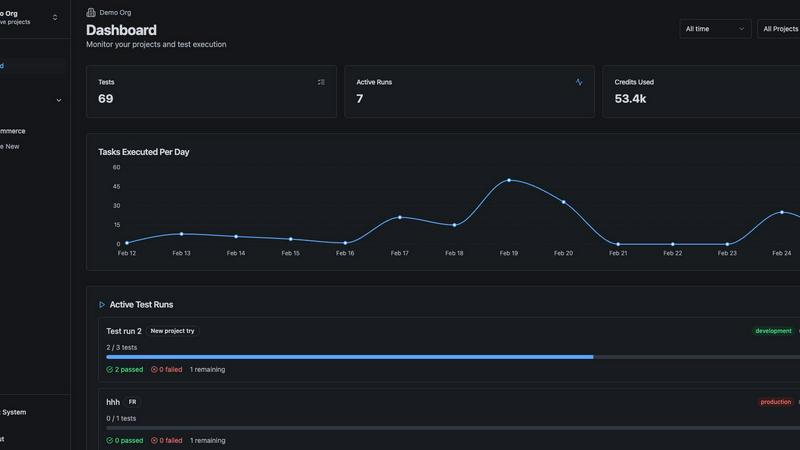
qtrl.ai is a modern, AI-powered QA platform engineered to help software development teams scale their quality assurance efforts effectively while maintaining full control and governance. It addresses the core challenges faced by modern QA teams by uniquely combining robust, enterprise-grade test management with intelligent, trustworthy AI automation. The platform serves as a centralized command center where teams can organize test cases, plan and execute test runs, trace requirements directly to test coverage, and monitor quality through comprehensive, real-time dashboards. This structured foundation provides engineering leads and QA managers with unparalleled visibility into testing status, pass/fail rates, and potential risk areas.
qtrl.ai distinguishes itself through its progressive approach to AI. Rather than imposing a risky, fully autonomous "black-box" solution, it allows teams to adopt intelligent automation at their own pace. Teams can begin with simple manual test management and seamlessly transition to leveraging built-in autonomous agents. These agents can generate precise UI tests from plain English instructions, autonomously maintain them as the application evolves, and execute them at scale across multiple browsers and environments. This makes qtrl.ai an ideal solution for product-led engineering teams, QA groups seeking to move beyond manual processes, companies modernizing legacy workflows, and enterprises that require strict compliance and detailed audit trails. Its mission is to bridge the gap between the slow pace of manual testing and the brittle complexity of traditional scripted automation, offering a trusted, scalable path to faster and more intelligent quality assurance.
Frequently Asked Questions
Agenta FAQ
What is LLMOps?
LLMOps refers to the operational practices and tools that enhance the development, deployment, and maintenance of large language models. It focuses on collaboration, experimentation, and systematic processes to improve reliability.
How does Agenta facilitate collaboration among teams?
Agenta brings together product managers, developers, and domain experts into a single workflow, enabling them to experiment, compare, version, and debug prompts with real data, all in one place.
Can Agenta integrate with existing tools and frameworks?
Yes, Agenta seamlessly integrates with various frameworks and models, including LangChain, LlamaIndex, and OpenAI, ensuring that teams can use their preferred tools without facing vendor lock-in.
Is Agenta suitable for small teams and startups?
Absolutely. Agenta is designed to support teams of all sizes, providing open-source solutions that facilitate effective collaboration, experimentation, and deployment, making it an ideal choice for small teams and startups.
qtrl.ai FAQ
How does qtrl.ai's AI differ from other "autonomous" testing tools?
qtrl.ai adopts a progressive, trust-first approach to AI, unlike tools that enforce a full "black-box" automation model from the start. Its AI agents operate with full transparency and within user-defined governance rules. Teams begin with manual oversight and gradually increase autonomy as the AI proves its reliability. This ensures control is never sacrificed, and all AI-generated tests and actions are fully reviewable and approvable by human team members.
Can qtrl.ai integrate with our existing development tools and pipelines?
Yes, qtrl.ai is built for real-world workflows and offers robust integration capabilities. It supports requirements management tools and seamlessly integrates with CI/CD pipelines to enable continuous testing. The platform is designed to work alongside your existing toolchain, providing continuous quality feedback loops without requiring a complete and disruptive overhaul of your current development and QA processes.
Is qtrl.ai suitable for teams that are currently only doing manual testing?
Absolutely. qtrl.ai is explicitly designed for progression, making it an ideal starting point for manual testing teams. You can begin by using its test management features to organize manual test cases and plans. When you're ready to automate, you can leverage the AI agents to execute existing manual instructions or generate new automated tests, allowing you to scale your QA efforts at your own comfortable pace.
How does qtrl.ai handle security and sensitive data during testing?
Security is a cornerstone of the platform. qtrl.ai offers enterprise-ready security protocols and a multi-environment execution system. Sensitive data like login credentials and API keys can be stored as encrypted secrets per environment. Crucially, these secrets are never exposed to the AI agents, ensuring that automated tests can run securely against staging or production environments without risking sensitive information.
Alternatives
Agenta Alternatives
Agenta is an open-source LLMOps platform tailored for AI teams striving to develop, evaluate, and deploy reliable large language model applications. With its emphasis on collaboration, it serves as a vital resource for cross-functional teams, addressing the unpredictability often associated with large language models through a centralized and structured development environment. Users often seek alternatives to Agenta for various reasons, including pricing concerns, feature sets that better fit their specific needs, or compatibility with existing platforms. When selecting an alternative, it's important to assess the platform's capabilities in terms of experimentation, evaluation processes, and overall integration with your existing workflow to ensure it aligns with your team's objectives and enhances productivity.
qtrl.ai Alternatives
qtrl.ai is a modern QA and test automation platform designed for software development teams. It combines structured test management with intelligent AI agents to help scale quality assurance efforts while maintaining governance and control. This places it within the broader categories of automation and developer tools. Users often explore alternatives to find a solution that best fits their specific needs. Common reasons include budget constraints, the need for different feature sets like integration capabilities or reporting, or a preference for a different deployment model. The specific requirements of a team's tech stack and existing development workflow also drive the search for other options. When evaluating alternatives, key considerations include the platform's approach to AI and automation, its ease of use for both technical and non-technical team members, and the strength of its test management foundation. It's also crucial to assess scalability, security compliance, and the quality of customer support to ensure a long-term fit for your organization's quality goals.