
Agenta vs Fallom
Side-by-side comparison to help you choose the right product.

Agenta is an open-source platform that streamlines LLM development for collaborative, reliable AI app creation.
Last updated: March 1, 2026

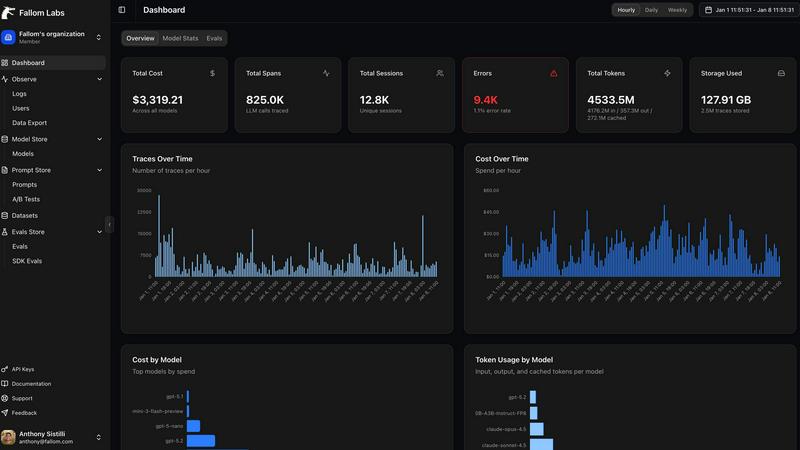
Fallom is an AI observability platform for tracking and optimizing LLM and agent operations.
Last updated: February 28, 2026
Visual Comparison
Agenta

Fallom
Feature Comparison
Agenta
Centralized Prompt Management
Agenta centralizes all prompts, evaluations, and traces within one platform, ensuring that teams have easy access to crucial resources. This eliminates the chaos of scattered documents and facilitates seamless collaboration among team members.
Unified Playground
The unified playground in Agenta allows teams to compare prompts and models side-by-side, fostering an environment of experimentation. Users can identify errors in production and save them to test sets for further analysis, improving overall efficiency.
Automated Evaluation
Agenta replaces guesswork with evidence through its automated evaluation feature. Teams can create systematic processes for running experiments, tracking results, and validating changes, ensuring that every modification is data-driven and justified.
Comprehensive Observability
The platform provides comprehensive observability tools that trace every request, enabling teams to pinpoint failure points effectively. Users can annotate traces collaboratively and turn any trace into a test with a single click, enhancing the feedback loop.
Fallom
End-to-End LLM Tracing
Fallom provides comprehensive tracing for every LLM call, capturing granular details in real-time. This includes the full prompt, model output, any function or tool calls made, token counts, latency metrics, and the calculated cost per call. This deep visibility is essential for debugging complex agentic workflows, understanding performance bottlenecks, and gaining a precise view of operational costs.
Cost Attribution and Transparency
The platform offers detailed cost tracking and attribution, breaking down spend by model, team, user, or customer. This provides full financial transparency for budgeting, forecasting, and internal chargeback processes. Teams can monitor live usage, set alerts for budget overruns, and make informed decisions about model selection based on both performance and cost-efficiency.
Compliance-Ready Audit Trails
Fallom is built for regulated industries, providing immutable, complete audit trails of every AI interaction. This includes full input/output logging, model versioning, and user consent tracking. These features are designed to help organizations meet stringent regulatory requirements such as the EU AI Act, SOC 2, and GDPR, ensuring accountability and traceability in AI operations.
Session Tracking and User Context
Group individual traces into complete user sessions to understand the full customer journey. This feature provides context for interactions, allowing teams to analyze how users engage with AI features, troubleshoot specific customer issues, and calculate the total cost-to-serve per user or account, enabling better product and support insights.
Use Cases
Agenta
Streamlined AI Development
AI development teams can utilize Agenta to streamline their workflows, moving from scattered prompts and siloed communication to a structured, collaborative environment that enhances productivity and reduces time to market.
Enhanced Collaboration
Product managers, developers, and domain experts can work together seamlessly in Agenta's integrated environment. This collaboration fosters innovation and ensures that everyone is on the same page, leading to higher-quality LLM applications.
Evidence-Based Decision Making
Teams can leverage the automated evaluation feature to validate their changes and decisions based on real data. This evidence-based approach helps in minimizing risks and improving the overall quality of AI products before deployment.
Debugging and Error Resolution
Agenta's observability tools allow teams to easily trace and debug errors in their AI systems. By providing visibility into request failures and enabling collaborative annotation, teams can pinpoint issues quickly and efficiently.
Fallom
Production Debugging and Performance Optimization
Engineering teams use Fallom to rapidly diagnose failures and latency issues in live AI applications. By examining timing waterfalls and tool call sequences, developers can pinpoint exactly where in a multi-step agent workflow a problem occurred, whether it's a slow LLM call, a failing tool, or a logic error, drastically reducing mean time to resolution (MTTR).
Financial Governance and Cost Control
Finance and engineering leadership utilize Fallom's cost attribution features to monitor and control AI expenditure. By tracking spend per model, team, or product feature, organizations can identify cost drivers, optimize expensive workflows, implement chargebacks, and ensure AI initiatives remain within budget, transforming AI costs from a black box into a manageable line item.
Regulatory Compliance and Auditing
Compliance and legal teams leverage Fallom to demonstrate adherence to AI regulations. The platform's immutable audit trails, consent tracking, and detailed logging provide the necessary evidence for audits required by standards like the EU AI Act or SOC 2. Privacy mode features also allow sensitive data to be redacted while maintaining operational telemetry.
Model Evaluation and A/B Testing
Product and ML teams employ Fallom to run evaluations, test new prompts, and safely roll out new model versions. The platform facilitates A/B testing by splitting traffic between models or prompt versions, allowing teams to compare performance, cost, and quality metrics like accuracy or hallucination rates before committing to a full production deployment.
Overview
About Agenta
Agenta is an open-source LLMOps platform specifically designed to empower AI teams in building, evaluating, and shipping reliable large language model (LLM) applications. By addressing the inherent unpredictability of LLMs, Agenta offers a structured and collaborative environment that streamlines the entire development lifecycle. It caters to cross-functional teams, including developers, product managers, and subject matter experts, who often struggle with disjointed workflows and scattered prompts. The platform serves as a single source of truth, centralizing crucial processes like experimentation, evaluation, and observability within one integrated system. By replacing ad-hoc testing methods with systematic processes, Agenta enables teams to version prompts, conduct automated and human evaluations, debug production issues with comprehensive traceability, and validate every change before deployment. This structured approach not only accelerates the building of AI applications but also enhances their robustness, measurability, and maintainability in production environments.
About Fallom
Fallom is an AI-native observability platform engineered specifically for monitoring and optimizing Large Language Model (LLM) and AI agent workloads in production environments. It provides engineering, product, and compliance teams with comprehensive, real-time visibility into every AI interaction, moving organizations from blind deployment to data-driven management of their AI applications. The platform's core value proposition is delivering end-to-end tracing for LLM calls, capturing granular details such as prompts, outputs, tool calls, token usage, latency, and per-call costs.
Built on the open standard OpenTelemetry (OTEL), Fallom offers a single, lightweight SDK that allows teams to instrument their applications in minutes, eliminating vendor lock-in. It is designed for enterprises that require scale, reliability, and compliance, featuring session-level context for user journeys, timing waterfalls for complex multi-step agents, and robust audit trails. By centralizing observability, Fallom empowers teams to debug issues faster, monitor usage live, attribute spend accurately across models and teams, and ensure their AI systems are performant, cost-effective, and compliant with regulations like the EU AI Act, SOC 2, and GDPR.
Frequently Asked Questions
Agenta FAQ
What is LLMOps?
LLMOps refers to the operational practices and tools that enhance the development, deployment, and maintenance of large language models. It focuses on collaboration, experimentation, and systematic processes to improve reliability.
How does Agenta facilitate collaboration among teams?
Agenta brings together product managers, developers, and domain experts into a single workflow, enabling them to experiment, compare, version, and debug prompts with real data, all in one place.
Can Agenta integrate with existing tools and frameworks?
Yes, Agenta seamlessly integrates with various frameworks and models, including LangChain, LlamaIndex, and OpenAI, ensuring that teams can use their preferred tools without facing vendor lock-in.
Is Agenta suitable for small teams and startups?
Absolutely. Agenta is designed to support teams of all sizes, providing open-source solutions that facilitate effective collaboration, experimentation, and deployment, making it an ideal choice for small teams and startups.
Fallom FAQ
How does Fallom integrate with my existing AI applications?
Fallom integrates via a single, lightweight OpenTelemetry (OTEL)-native SDK. You can instrument your applications in under five minutes by adding the SDK, which automatically captures traces from LLM calls, tool usage, and custom spans. Being OTEL-based, it avoids vendor lock-in and works with a wide range of LLM providers and frameworks.
Does Fallom store sensitive user data from prompts and responses?
Fallom offers a configurable Privacy Mode to address this concern. You can choose to disable full content capture for sensitive data, redact specific fields, or log only metadata (like token counts and latency) while protecting confidential information. This allows you to maintain full observability for debugging while adhering to data privacy policies.
Can Fallom track costs for different teams or projects?
Yes, detailed cost attribution is a core feature. Fallom automatically breaks down costs by the LLM model used. You can further enrich traces with custom attributes (like team ID, project name, or user ID) to slice and dice spending across any dimension, enabling precise showback/chargeback and helping teams understand their AI resource consumption.
Is Fallom suitable for large-scale enterprise deployments?
Absolutely. Fallom is engineered for enterprise-scale, reliability, and security. It handles high-volume tracing data, offers robust access controls, and provides features essential for large organizations, including comprehensive audit trails, SOC 2/GDPR-ready compliance tools, and the ability to monitor complex, multi-agent AI systems across entire product suites.
Alternatives
Agenta Alternatives
Agenta is an open-source LLMOps platform tailored for AI teams striving to develop, evaluate, and deploy reliable large language model applications. With its emphasis on collaboration, it serves as a vital resource for cross-functional teams, addressing the unpredictability often associated with large language models through a centralized and structured development environment. Users often seek alternatives to Agenta for various reasons, including pricing concerns, feature sets that better fit their specific needs, or compatibility with existing platforms. When selecting an alternative, it's important to assess the platform's capabilities in terms of experimentation, evaluation processes, and overall integration with your existing workflow to ensure it aligns with your team's objectives and enhances productivity.
Fallom Alternatives
Fallom is an AI-native observability platform designed for monitoring and optimizing Large Language Model (LLM) and AI agent operations in production. It falls into the category of specialized development tools for AI application management, providing end-to-end tracing, cost analysis, and compliance features. Users may explore alternatives to Fallom for various reasons, including budget constraints, specific feature requirements not covered, or a need for a platform that integrates more tightly with their existing tech stack. Different organizations have unique priorities, such as open-source flexibility, different pricing models, or specialized support for certain cloud providers or agent frameworks. When evaluating an alternative, key considerations should include the depth of LLM and agent tracing capabilities, support for compliance and audit trails, ease of integration and vendor lock-in, scalability for enterprise workloads, and the overall total cost of ownership. The goal is to find a solution that delivers the necessary visibility and control for your specific AI deployment.