
Activepieces vs Agent to Agent Testing Platform
Side-by-side comparison to help you choose the right product.

Activepieces
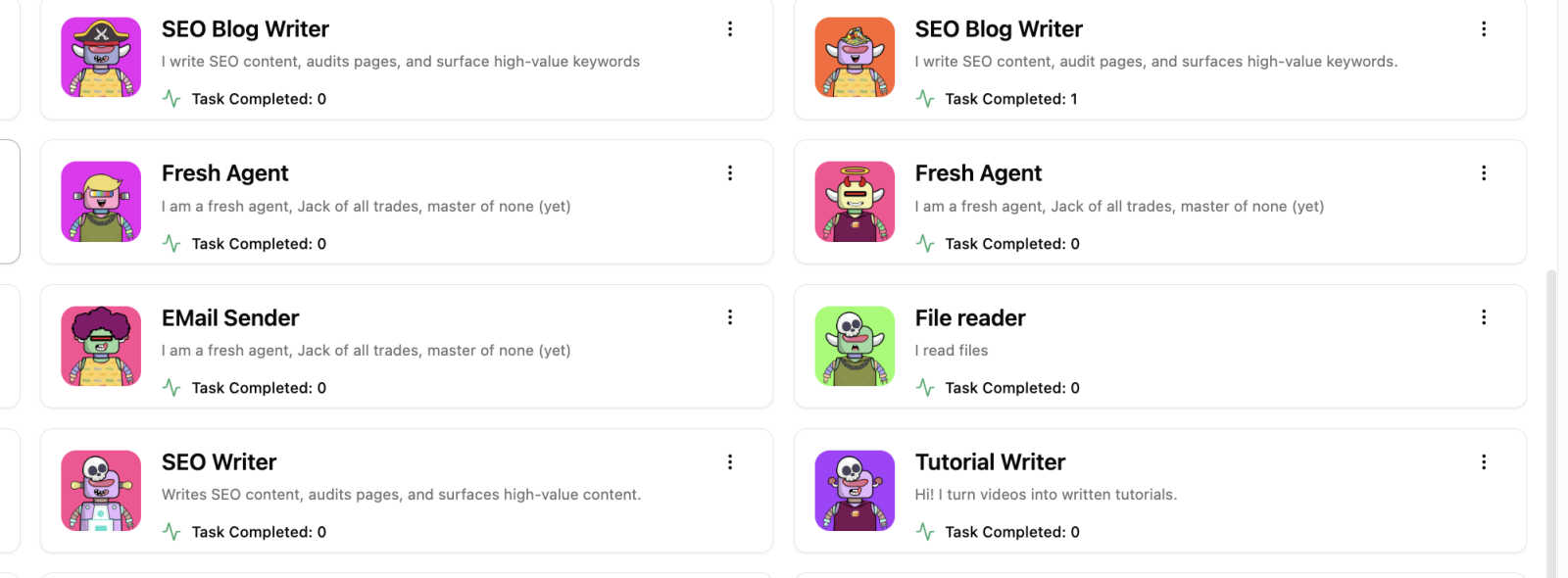
Activepieces is an open source AI agent platform for building smart automations without code.
Last updated: March 1, 2026

Agent to Agent Testing Platform
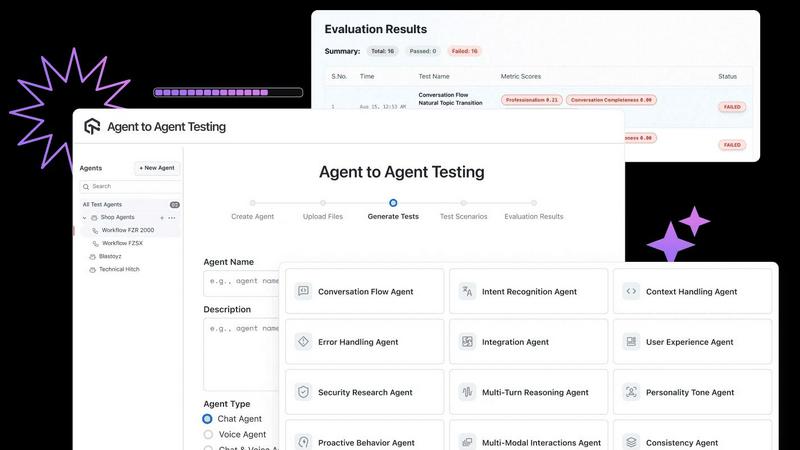
The Agent to Agent Testing Platform evaluates AI agents across multiple modalities to ensure compliance and mitigate.
Last updated: February 26, 2026
Visual Comparison
Activepieces
Agent to Agent Testing Platform
Feature Comparison
Activepieces
No-Code AI Agent Builder
The platform features an intuitive, visual drag-and-drop builder that allows anyone to create and customize AI agents. Users can define triggers, actions, and complex logic flows by connecting pre-built pieces, enabling the construction of sophisticated automations without writing a single line of code. This opens up AI agent development to business teams, marketers, and operations personnel, drastically reducing the barrier to entry for intelligent automation.
Extensive Integration Library
Activepieces offers native connections to over 638 popular tools and applications across categories like communication, CRM, productivity, and databases. This vast library includes services such as Gmail, Slack, OpenAI, Notion, and HubSpot, allowing users to build agents that interact with their entire software stack. The seamless connectivity ensures that AI agents can read data, take actions, and synchronize information across all critical business platforms.
Enterprise Control & Governance
The platform provides a suite of IT oversight tools designed for enterprise security without hindering productivity. Features include Single Sign-On (SSO) with SAML 2.0, SCIM provisioning for automatic user management, and advanced Role-Based Access Control (RBAC). Admins can define granular permissions, manage users, and maintain full visibility through audit logs, ensuring compliance and secure AI adoption at scale.
Flexible Deployment Options
Activepieces offers two primary deployment models to suit different organizational needs. The fully managed Cloud option provides a quick start with SOC 2 Type II compliance, GDPR adherence, and zero maintenance. For maximum control, the Self-Hosted option allows deployment on your own infrastructure via Docker or Helm, keeping all data within your private network to meet strict compliance requirements, with free dev and staging environments.
Agent to Agent Testing Platform
Automated Scenario Generation
This feature allows for the creation of diverse and dynamic test cases that simulate chat, voice, and phone interactions for AI agents. Automated scenario generation ensures that testing encompasses a wide array of potential user interactions, increasing reliability.
True Multi-Modal Understanding
The platform supports multi-modal testing by allowing users to define detailed requirements and upload various input formats, including images, audio, and video. This capability mirrors real-world scenarios, enabling a comprehensive assessment of AI agents beyond just text interactions.
Autonomous Test Scenario Generation
With access to a library of hundreds of predefined scenarios, users can also create custom scenarios tailored to specific needs. This feature helps assess AI agents across various roles, such as personality tone and intent recognition, ensuring they perform as intended in diverse contexts.
Regression Testing with Risk Scoring
The platform offers end-to-end regression testing with insights into risk scoring, which highlights potential areas of concern. This feature enables testers to prioritize critical issues effectively, optimizing testing efforts and ensuring that the AI agents maintain their quality over time.
Use Cases
Activepieces
Automated Lead Qualification & Routing
Sales and marketing teams can build an AI agent that automatically qualifies incoming leads from forms or emails. The agent can score leads based on predefined criteria, enrich contact data, and instantly route high-potential leads to the correct sales representative in the CRM while sending automated follow-up emails to others, ensuring no opportunity is missed and improving sales team efficiency.
Intelligent Customer Support Triage
Support teams can deploy AI agents to automatically categorize, prioritize, and route customer support tickets from channels like email or chat. The agent can analyze the ticket content, suggest solutions from a knowledge base, and escalate only complex issues to human agents. This reduces resolution time, improves customer satisfaction, and allows support staff to focus on high-value interactions.
Personalized Marketing Campaign Execution
Marketing departments can orchestrate agents to execute personalized, multi-channel campaigns. An agent can trigger based on customer behavior, segment audiences from a database, generate personalized content using AI, and schedule deliveries across email, social media, and messaging platforms like Slack, all while tracking engagement and updating customer profiles automatically.
Automated Internal Reporting & Notifications
Operations and management can create agents to automate routine reporting. An agent can gather data from various business tools (e.g., analytics, CRM, project management), synthesize it into a formatted daily or weekly report, and distribute it via email or Slack to relevant teams and stakeholders. This saves hours of manual work and ensures consistent, timely dissemination of critical business insights.
Agent to Agent Testing Platform
Enhancing Chatbot Performance
Enterprises can utilize this platform to systematically evaluate their chatbots across multiple scenarios, ensuring they handle user interactions effectively and meet performance benchmarks related to engagement and satisfaction.
Validating Voice Assistants
Organizations developing voice assistants can leverage the multi-modal understanding feature to test voice interactions. This ensures that the assistant responds accurately and appropriately across various contexts, enhancing user trust and usability.
Testing Hybrid AI Agents
This platform is particularly useful for testing hybrid AI agents that operate across different channels. By simulating diverse user interactions, businesses can ensure consistency in performance regardless of the platform being used.
Ensuring Compliance and Ethical Standards
The Agent to Agent Testing Platform can help organizations assess AI agents for compliance with ethical standards by evaluating metrics such as bias and toxicity. This process is crucial for maintaining brand integrity and trust in AI technologies.
Overview
About Activepieces
Activepieces is a comprehensive, open-source AI Agent ecosystem designed to democratize intelligent automation. It empowers users to build smart, autonomous AI agents capable of handling complex, repetitive tasks without requiring any coding knowledge. The platform functions as a full-stack solution for creating sophisticated, AI-driven workflows that seamlessly connect to over 638 business tools and applications, including Gmail, Slack, Notion, HubSpot, and CRMs. It is built for a diverse audience, from non-technical business users and operations teams seeking efficiency to developers in startups and large enterprises, including Fortune 50 companies. The core value proposition lies in enabling organizations to accelerate processes, eliminate human error, and construct collaborative systems of AI agents through an intuitive, visual no-code builder. Users can create individual agents or orchestrate entire teams of specialized agents that work together to complete multi-step processes like lead qualification, personalized communication, and client onboarding. With robust features for control, governance, and deployment, Activepieces provides the tools necessary for secure and scalable AI adoption across entire organizations.
About Agent to Agent Testing Platform
Agent to Agent Testing Platform is a pioneering AI-native quality and assurance framework tailored specifically for validating the behavior of AI agents in real-world scenarios. As AI systems grow more autonomous and complex, traditional quality assurance methods designed for static software become inadequate. This platform transcends basic prompt-level evaluations, providing comprehensive assessments of multi-turn conversations across various mediums, including chat, voice, and phone interactions. It is ideal for enterprises aiming to ensure their AI agents are reliable and effective before deployment. The platform facilitates detailed analysis of critical metrics such as bias, toxicity, and hallucination, enabling organizations to mitigate risks and enhance user experience.
Frequently Asked Questions
Activepieces FAQ
What is an AI Agent in Activepieces?
In Activepieces, an AI Agent is an autonomous workflow built using the no-code builder that can perform tasks, make decisions, and interact with other software. It typically consists of a trigger (an event that starts it), a series of actions or logic steps, and integrations with external tools. These agents can operate independently or as part of a coordinated team to handle complex, multi-step business processes intelligently.
Who is the target user for Activepieces?
Activepieces is designed for a wide range of users. Non-technical business users, operations teams, and citizen developers can use it to automate tasks without code. Simultaneously, professional developers and IT teams in startups to large enterprises leverage it for its extensibility, governance features, and self-hosting capabilities to build and manage secure, company-wide automation systems.
How does Activepieces ensure security for enterprises?
Activepieces provides enterprise-grade security through multiple layers. For cloud deployments, it is SOC 2 Type II compliant and adheres to GDPR. It offers SSO (SAML 2.0), SCIM provisioning, and detailed audit logs. For the highest security needs, the self-hosted option allows data to remain entirely within your private network, giving full control over compliance with industry-specific regulations.
Can I extend the functionality of Activepieces agents?
Yes, Activepieces is highly extensible. Beyond the 638+ native integrations, you can use Webhooks to connect to any API. For advanced AI capabilities, you can utilize Model Context Protocols (MCPs) to connect agents to large language models like Claude. Developers can also create custom pieces (integration components) using TypeScript to add any specialized functionality required for unique business processes.
Agent to Agent Testing Platform FAQ
What types of AI agents can be tested with this platform?
The Agent to Agent Testing Platform supports various AI agents, including chatbots, voice assistants, and phone caller agents, across multiple interaction scenarios.
How does automated scenario generation work?
Automated scenario generation utilizes algorithms to create diverse test cases that simulate real-world interactions, ensuring a comprehensive assessment of AI agent performance in various situations.
Can I integrate the platform with existing CI/CD tools?
Yes, the platform seamlessly integrates with existing CI/CD tools, allowing for large-scale cloud execution and efficient management of test scenarios.
What metrics can be measured during testing?
Key metrics that can be evaluated include bias, toxicity, hallucination, effectiveness, accuracy, empathy, and professionalism, providing a holistic view of AI agent performance.
Alternatives
Activepieces Alternatives
Activepieces is an open-source AI agent platform that enables users to build intelligent automations and autonomous workflows without code. It falls into the categories of AI assistants and development tools, providing a visual builder to connect numerous apps and orchestrate teams of AI agents. Users often explore alternatives for various reasons. These can include budget constraints, specific feature requirements not met by the current platform, or the need for a different deployment model like a fully managed cloud service versus self-hosted software. The search for the right tool is highly individual. When evaluating an alternative, key considerations include the platform's core focus, such as whether it prioritizes simple app connections or complex AI agent orchestration. Other factors are the total cost of ownership, the breadth and depth of native integrations, the learning curve, and the level of control over data and hosting.
Agent to Agent Testing Platform Alternatives
Agent to Agent Testing Platform is a pioneering AI-native quality assurance framework that validates the behavior of AI agents across various communication channels, including chat, voice, and phone. This innovative platform is essential in a landscape where AI systems are increasingly autonomous and complex, making traditional quality assurance models inadequate. Users often seek alternatives due to factors such as pricing, specific feature sets, or particular platform requirements that better align with their business needs. When considering alternatives, it is crucial to evaluate the specific functionalities offered, the scalability of the solution, and the overall user experience. Look for platforms that provide comprehensive testing capabilities, ensuring thorough validation of AI agent interactions in real-world scenarios. Prioritizing flexibility and adaptability to suit unique operational demands will also be essential in your decision-making process.