
UPCgen
UPCgen generates GS1-valid barcodes for Amazon, Shopify, and 50+ platforms with bulk export and no sign-up required.
Visit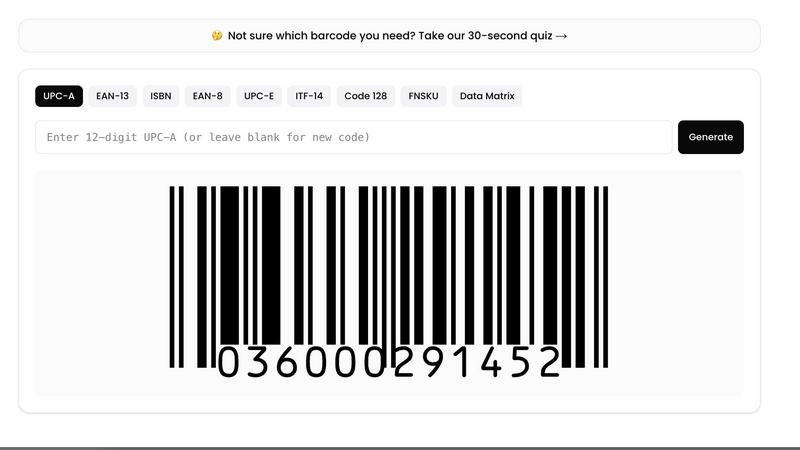
About UPCgen
UPCgen is a streamlined, web-based barcode generation platform designed to meet the needs of e-commerce sellers, warehouse operators, publishers, and developers who require valid, GS1-standard barcodes in seconds. Unlike traditional barcode tools that are either bloated with unnecessary features, confusing with endless checkbox options, or dishonest about issuing "free" UPCs that collide with registered products, UPCgen offers a clean, honest, and efficient solution. The platform supports a comprehensive range of barcode symbologies including UPC-A, UPC-E, EAN-13, EAN-8, ISBN, ITF-14, Code 128, FNSKU, and Data Matrix. Its primary value proposition lies in generating codes that are instantly valid, platform-approved for major marketplaces like Amazon, Shopify, Etsy, eBay, and Walmart, and ready for bulk export in multiple formats such as CSV, PNG, PDF, SVG, and EPS. UPCgen is built for Amazon FBA sellers printing FNSKU labels, Shopify and Etsy sellers adding GTINs to listings, warehouses and third-party logistics providers labeling outer cases with ITF-14, self-publishers generating ISBN barcodes, pharma operators producing Data Matrix codes for DSCSA and FMD compliance, and developers integrating barcode generation via API. The platform emphasizes transparency and honesty, clearly stating when users need a real GS1 number versus when a generated code is sufficient for internal or labeling purposes. With a focus on simplicity and speed, UPCgen eliminates the complexity of traditional barcode software, offering a single, intuitive page where users can select their barcode type, generate a valid code, and download it cleanly.
Features of UPCgen
GS1 Standard Validation
Every barcode generated through UPCgen undergoes rigorous GS1 standard validation to ensure the check digit is correct and the code structure meets industry requirements. This validation process guarantees that the generated barcodes are not only mathematically accurate but also compatible with scanning systems used across retail, logistics, and healthcare sectors. Users can trust that their codes will scan reliably in any environment, from Amazon fulfillment centers to pharmacy supply chains. This feature eliminates the common problem of generating codes that fail validation when uploaded to marketplace portals or printed on product packaging. The system automatically calculates and appends the correct check digit, removing manual calculation errors and saving time for users who need to generate multiple codes quickly.
Platform-Approved Compatibility
UPCgen ensures that all generated barcodes meet the specific requirements of major e-commerce and retail platforms including Amazon, Shopify, Etsy, eBay, and Walmart supplier portals. This feature is critical for sellers who need to add GTINs, UPCs, or FNSKUs to their product listings without facing rejection or compliance issues. The platform understands that each marketplace has unique formatting and validation standards, and it tailors its output to align with these requirements. For example, Amazon FBA sellers can generate FNSKU barcodes that are immediately compatible with Amazon's labeling system, while Shopify merchants can create GTIN-compliant barcodes that integrate seamlessly with their inventory management. This platform-specific focus saves users from the frustration of generating codes that look correct but fail to work within their chosen selling ecosystem.
Bulk Generation and Multi-Format Export
UPCgen supports generating from 1 to 10,000 barcodes in a single session, making it ideal for businesses with large product catalogs or warehouses needing to label thousands of items. The bulk generation feature is paired with flexible export options that include CSV files for inventory management, PNG sheets for label printing, PDF documents for professional packaging, SVG and EPS vector formats for high-resolution printing. This versatility ensures that users can produce barcodes in the exact format required by their workflow, whether they are printing labels in-house, sending files to a commercial printer, or uploading data to a supplier portal. The ability to export in multiple formats eliminates the need for additional conversion tools or manual adjustments, streamlining the entire barcode production process from generation to application.
Anonymous and Registered Generation Tiers
UPCgen offers a flexible access model that accommodates both casual users and frequent generators. Anonymous users can generate one barcode every 24 hours without any registration, making the platform accessible for quick, one-off needs. For users who require more frequent access, free registration unlocks the ability to generate five codes every 24 hours. This tiered approach allows individuals and small businesses to test the platform and generate occasional codes without financial commitment. For higher-volume needs, subscription plans provide unlimited generation capabilities, ensuring that professional users and enterprises never face generation limits. This structure ensures that UPCgen remains accessible to all users while providing a clear upgrade path for those with growing barcode requirements.
Use Cases of UPCgen
Amazon FBA Labeling and Inventory Management
Amazon FBA sellers rely on UPCgen to generate FNSKU barcodes that comply with Amazon's strict labeling requirements for fulfillment center operations. The platform enables sellers to produce accurate, scannable labels for individual products, ensuring smooth receiving and inventory tracking within Amazon's network. By generating codes that pass Amazon's validation checks, sellers avoid costly delays and return fees associated with incorrect or unreadable barcodes. The bulk generation feature is particularly valuable for sellers launching new product lines or managing large inventories, allowing them to create hundreds of FNSKU codes in minutes and export them as printable PDF sheets or CSV files for integration with inventory management software.
E-commerce Marketplace GTIN Compliance
Shopify, Etsy, and eBay sellers use UPCgen to generate GTINs and UPCs that meet the product listing requirements of these platforms. Many marketplaces require unique identifiers for product cataloging and search optimization, and UPCgen provides codes that are immediately valid for submission. Sellers can generate EAN-13 codes for international listings or UPC-A codes for North American markets, ensuring their products appear correctly in search results and checkout systems. The platform's validation feature guarantees that each code has a correct check digit, preventing listing errors that can result in product suppression or account warnings. This use case is essential for sellers expanding from local to global markets who need to comply with varying regional barcode standards.
Warehouse and Logistics Labeling for Outer Cases
Warehouses and third-party logistics providers leverage UPCgen to generate ITF-14 barcodes for labeling outer cases and pallets. These barcodes are essential for tracking inventory through supply chains, managing shipping processes, and ensuring accurate receiving at distribution centers. The platform's ability to produce codes in bulk and export them as high-resolution vector graphics ensures that labels remain scannable even when printed on large corrugated boxes or applied in challenging warehouse environments. Logistics operators can generate thousands of unique ITF-14 codes for different product variants, case configurations, and customer orders, streamlining their barcode management and reducing the risk of scanning errors during high-volume operations.
Pharmaceutical Data Matrix Codes for Compliance
Pharma operators and healthcare supply chain professionals use UPCgen to generate Data Matrix barcodes that comply with pharmaceutical traceability regulations such as the Drug Supply Chain Security Act (DSCSA) in the United States and the Falsified Medicines Directive (FMD) in Europe. These two-dimensional barcodes encode critical product information including lot numbers, expiration dates, and serial numbers, enabling end-to-end traceability from manufacturer to patient. UPCgen's Data Matrix generator ensures that codes meet the technical specifications required by regulatory bodies and scanning systems used in pharmacies and hospitals. This use case is vital for pharmaceutical companies, wholesalers, and dispensaries that must comply with increasingly stringent serialization requirements to combat counterfeit drugs and ensure patient safety.
Frequently Asked Questions
What barcode types does UPCgen support?
UPCgen supports a comprehensive range of barcode symbologies including UPC-A, UPC-E, EAN-13, EAN-8, ISBN, ITF-14, Code 128, FNSKU, and Data Matrix. Each barcode type is generated with correct check digits and passes GS1 standard validation. The platform is designed to cover the most common barcode needs for e-commerce, retail, publishing, logistics, and pharmaceutical applications. Users can select their desired barcode type from the main interface and generate codes that are immediately compatible with their intended use case.
Do I need a GS1 company prefix to use UPCgen codes?
UPCgen is transparent about the difference between generated codes and officially registered GS1 numbers. The platform generates codes that are valid in structure and check digit but are not issued by GS1. For internal use, inventory tracking, or labeling products that are not sold through retail channels that require registered UPCs, generated codes are sufficient. However, if you are selling products through major retailers like Walmart, Target, or Amazon that require a GS1-registered UPC, you will need to purchase a legitimate GS1 company prefix and assign your own numbers. UPCgen provides clear guidance on when a GS1 number is necessary versus when a generated code is appropriate.
Can I generate barcodes in bulk for my entire product catalog?
Yes, UPCgen supports bulk generation of up to 10,000 barcodes in a single session. This feature is particularly useful for businesses with large product catalogs, warehouses needing to label thousands of items, or publishers generating ISBN barcodes for multiple titles. After generating codes in bulk, you can export them in various formats including CSV for inventory management, PNG sheets for label printing, PDF for professional packaging, and SVG or EPS for high-resolution print. The bulk generation process is streamlined to minimize time and ensure all codes are unique and valid.
What export formats are available for downloaded barcodes?
UPCgen offers multiple export formats to accommodate different use cases and printing requirements. Users can download barcodes as PNG images for quick use, PDF documents for professional printing, SVG and EPS vector files for high-resolution output, and CSV spreadsheets for inventory management and data integration. Vector formats like SVG and EPS are ideal for commercial printing because they scale to any size without losing quality. The CSV export includes both the barcode image data and the numeric code, making it easy to import into label design software or inventory systems.
Explore more in this category:
Similar to UPCgen

Practical, independent guides to home repairs, maintenance, costs, troubleshooting, and everyday fixes.

Highlight faster. Study in flow with custom shortcuts and a workflow built around you. Print smarter, or turn any page into a tiled poster.

Build Mode is a Mac app that turns focused sessions into visible progress, so you can see the work adding up before the results arrive.

Free, no-signup Unicode text tools: superscript, fancy fonts, case converter, symbols. Fast and private.

Free, open-source scheduler. Web/mobile/API. Fees.


Capture any workflow in your browser and export a branded, step-by-step SOP with screenshots. €5 per document, no subscription.