
About Rock Smith
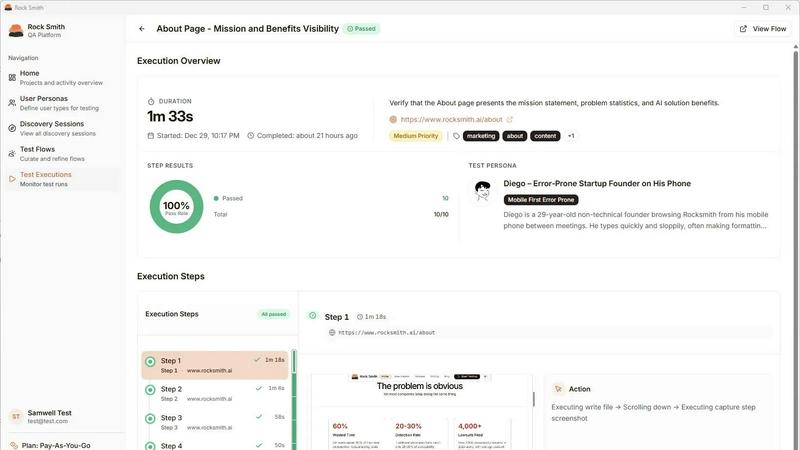
Rock Smith is an AI-powered black box QA testing platform that revolutionizes web application testing by deploying autonomous AI agents. It is engineered for fast-moving engineering teams, including QA engineers, developers, and business leaders, who need to ensure robust application quality without the bottlenecks of manual processes or fragile automation. The platform fundamentally shifts the paradigm of test automation by abandoning traditional, brittle methods that depend on CSS selectors and XPath expressions. Instead, Rock Smith utilizes advanced visual intelligence, enabling its AI agents to perceive and interact with your application exactly as a human user would. This is accomplished through semantic element targeting, where UI components are identified by their visual characteristics and contextual meaning—such as "the blue Submit button below the form." This innovative approach allows tests to self-heal when the user interface evolves, dramatically reducing maintenance overhead and eliminating flaky, unreliable tests. The core value proposition is clear: empower teams to ship high-quality software faster and with greater confidence by providing intelligent, adaptive, and secure automated testing that authentically simulates real user behavior.
Features of Rock Smith
Visual Intelligence & Semantic Targeting
Rock Smith's core technology is its visual intelligence engine. Instead of relying on fragile code selectors that break with UI changes, its AI agents use semantic descriptions to identify elements. They understand the application visually, targeting items based on their appearance, label text, and position relative to other elements. This method, such as instructing an agent to click "the login button in the top-right corner," makes test scripts inherently more robust and readable, closely mirroring how a human tester would describe their actions.
Autonomous AI Testing Agents
The platform operates through autonomous AI agents that execute testing workflows independently. These agents can navigate complex user journeys, input data, click buttons, and validate outcomes without continuous human intervention. They are designed to simulate real user behavior at scale, performing regression testing, new feature validation, and user flow verification autonomously, which frees engineering teams from repetitive manual execution and allows for continuous testing.
Self-Healing Test Automation
One of the most significant features is the self-healing capability of test scripts. When a website's UI changes—such as a button moving or its color being altered—traditional automation scripts fail. Rock Smith's visual AI can adapt to these changes by re-identifying the target element based on its updated semantic and visual context. This drastically reduces the maintenance burden typically associated with test automation, ensuring test suites remain reliable over time without constant manual updates.
Secure Black-Box Testing
Rock Smith performs black-box testing, interacting with the application solely through its user interface, just like an end-user. This approach requires no access to the underlying source code, internal APIs, or databases. It provides a security-friendly testing method that assesses the application from an external perspective, validating the complete user experience and ensuring that security and functionality are tested from the point of view of someone who does not have internal system knowledge.
Use Cases of Rock Smith
Continuous Regression Testing
Engineering teams can integrate Rock Smith into their CI/CD pipelines to run comprehensive regression test suites automatically after every code commit or deployment. The autonomous AI agents verify that new changes have not broken existing core functionalities. The self-healing nature of the tests ensures the pipeline remains green and reliable, catching regressions early and preventing bugs from reaching production, thereby accelerating release cycles.
Cross-Browser and Cross-Device Validation
Teams can use Rock Smith to automate testing across multiple browser types (Chrome, Firefox, Safari) and device viewports. The visual AI agents interact with the application in each environment, checking for layout inconsistencies, functional bugs, or responsive design issues. This ensures a consistent and high-quality user experience for all customers, regardless of how they access the web application.
User Journey and Acceptance Testing
Product managers and QA teams can script and automate complex, multi-step user acceptance tests (UAT). For instance, testing a complete e-commerce checkout flow from product search to payment confirmation. Rock Smith's agents execute these journeys precisely, validating that all integrated components work together seamlessly from the user's perspective, which is crucial for validating new features before launch.
Rapid Smoke Testing for Critical Paths
Following a deployment, teams can execute rapid smoke tests on the most critical user paths to ensure core application stability. Rock Smith can quickly run through essential workflows like user login, data submission, and key navigation. This provides immediate feedback on deployment health, allowing teams to confirm basic functionality is intact before proceeding with more in-depth testing or announcing the release.
Frequently Asked Questions
How does Rock Smith differ from traditional test automation tools like Selenium?
Traditional tools like Selenium rely on code-based selectors (CSS, XPath) that are tightly coupled to the application's underlying HTML structure. When developers change the UI, these selectors often break, causing test failures that require manual script updates. Rock Smith uses visual AI and semantic understanding, so its tests are based on what the user sees and interacts with. This makes tests more resilient to UI changes, as the AI can adapt to find "the login button" even if its HTML ID changes, leading to lower maintenance and fewer flaky tests.
Is technical coding knowledge required to create tests with Rock Smith?
A core design principle of Rock Smith is to make powerful test automation accessible. While some technical understanding is beneficial, the platform's use of natural, semantic language for describing test steps (e.g., "enter text into the email field") significantly lowers the barrier to entry. This allows product managers, business analysts, and manual QA testers to contribute to and understand automated test suites without needing deep programming expertise.
Can Rock Smith test applications behind a login or with complex state?
Yes, Rock Smith's AI agents are designed to handle stateful applications. They can manage user sessions, log in with provided credentials, navigate through multi-step processes, and maintain context throughout a testing workflow. The platform can interact with forms, modals, and dynamic content, making it suitable for testing complex, authenticated web applications like SaaS platforms, customer portals, and internal business tools.
How does the self-healing feature actually work?
When a UI change occurs, Rock Smith's visual AI re-scans the application interface. It uses the original semantic instruction (e.g., "the submit button") and contextual clues to locate the intended element in its new state. The AI considers visual attributes, proximity to other elements, and functional roles. Once it successfully re-identifies the target, it updates its internal reference and continues the test execution, often without any human intervention required to fix the script.