
Kelda
Kelda cross-references your labs, medications, symptoms, and wearables to reveal hidden health patterns and connections you are missing.
Visit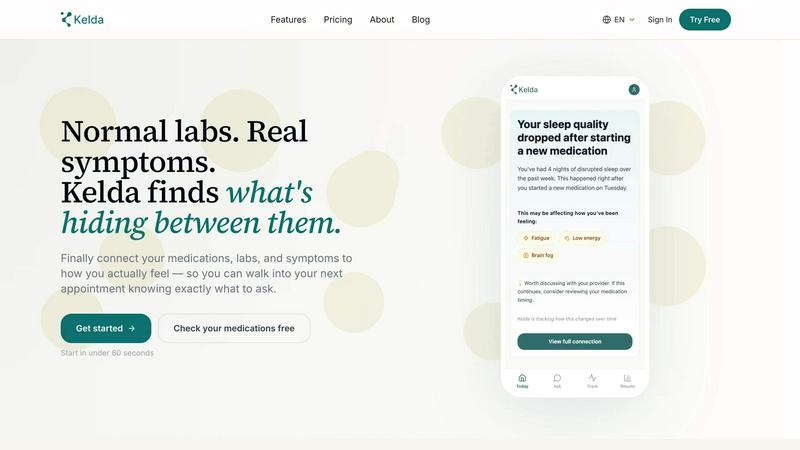
About Kelda
Kelda is a comprehensive health and wellness platform designed to help individuals understand the complex connections between their medications, nutrients, biomarkers, symptoms, and overall wellbeing. The platform addresses a critical gap in modern healthcare where patients often receive lab results marked "within range" yet continue to experience persistent symptoms that remain unexplained. Kelda cross-references medications, laboratory results, symptoms, and wearable device data in one centralized location to identify patterns that are easy to miss in fragmented care systems. The platform is built for people who have seen multiple doctors, completed numerous tests, and still feel stuck without clear answers about their health. Kelda specializes in uncovering medication-induced nutrient depletions, suboptimal lab values that fall within standard ranges but below optimal thresholds for health, and connections between lifestyle factors and chronic conditions. By combining educational resources, structured health content, and practical insights, Kelda empowers users to move from confusion to clarity. The platform simplifies complex health information and makes it easier to explore how prescriptions, vitamin status, and lab results may relate to energy levels, mood stability, metabolic function, and long-term health patterns. Users can walk into medical appointments more informed and have more productive conversations with their healthcare providers. Kelda serves individuals managing conditions including PCOS, hypothyroidism, iron deficiency, B12 deficiency, endometriosis, perimenopause, fibromyalgia, insulin resistance, IBS, Hashimoto's, chronic fatigue, anxiety, depression, migraine, autoimmune conditions, hormonal imbalance, and many other complex health challenges.
Features of Kelda
Medication Depletion Analysis
Kelda systematically cross-references every medication a user takes against known nutrient depletion patterns documented in scientific research. For example, the platform can identify that omeprazole may be depleting magnesium, which is commonly linked to fatigue, muscle cramps, and poor sleep quality. This feature goes beyond basic drug interaction checkers by focusing on how medications gradually reduce essential vitamins and minerals over time, contributing to symptoms that users may not associate with their prescriptions. Kelda provides clear explanations of these depletion mechanisms and offers actionable guidance for discussing supplementation options with healthcare providers.
Lab Result Optimization Insights
Kelda analyzes laboratory results using optimal reference ranges rather than standard clinical cutoffs that often miss subclinical deficiencies. When a user's ferritin level is 25, a standard lab report may mark it as normal, but Kelda identifies that optimal ferritin for preventing hair loss and maintaining energy levels starts at 70. This feature helps users understand the difference between being "within range" and being truly optimized for health. Kelda provides context for each biomarker, explains how it relates to specific symptoms, and offers research-informed guidance for discussing optimization strategies with healthcare professionals.
Symptom Pattern Detection
Kelda connects the dots between symptoms, medications, lab results, and wearable device data to identify patterns that individual doctors may overlook. When a user's sleep quality drops after starting a new medication, and their energy and mood shift at the same time, Kelda flags this as a potential pattern worth investigating. The platform tracks symptom trajectories over time and correlates them with changes in medication regimens, supplement timing, and lifestyle factors. This systematic approach helps users identify root causes rather than treating symptoms in isolation.
Comprehensive Health Data Integration
Kelda brings together laboratory results, medication lists, symptom logs, and wearable device data into one unified dashboard. Users can upload lab reports from multiple providers, maintain an up-to-date medication list with dosages and timing, track daily symptoms with severity ratings, and sync data from popular wearable devices. This integration eliminates the fragmentation that plagues modern healthcare, where each specialist sees only part of the picture. Kelda presents all this information in a structured, easy-to-navigate format that users can share with their healthcare providers during appointments.
Use Cases of Kelda
Identifying Hidden Medication Side Effects
A user prescribed omeprazole for acid reflux notices persistent fatigue and muscle cramps that their doctor attributes to stress or aging. Kelda cross-references the medication against known nutrient depletion patterns and identifies that omeprazole commonly depletes magnesium, vitamin B12, and calcium. The platform explains how magnesium deficiency specifically manifests as fatigue, muscle cramps, and poor sleep. The user can then discuss magnesium supplementation with their doctor, potentially resolving symptoms that had been dismissed or misattributed for months.
Optimizing Lab Results for Chronic Conditions
A woman with hypothyroidism has been managing her condition for years with standard thyroid medication. Her TSH is within the normal range, but she continues to experience fatigue, weight gain, and brain fog. Kelda analyzes her full thyroid panel including free T3, free T4, reverse T3, and thyroid antibodies. The platform identifies that her T3 level is suboptimal for her age and activity level, and her ferritin is too low for proper thyroid hormone conversion. Kelda provides specific talking points for her next endocrinology appointment to address these optimization opportunities.
Connecting Symptoms Across Multiple Specialties
A user with fibromyalgia, IBS, and anxiety has been seeing three different specialists who each treat their respective conditions independently. Kelda aggregates all symptoms, medications, and lab results into one view and identifies a pattern: the user's gut issues started shortly after beginning a medication for anxiety, and their fibromyalgia flares correlate with periods of poor sleep tracked by their wearable device. Kelda suggests that the medication may be affecting gut motility and nutrient absorption, which in turn impacts sleep quality and pain levels. This holistic view enables a coordinated treatment approach.
Tracking Postpartum Recovery Patterns
A mother who has been pregnant or breastfeeding for five consecutive years experiences recurrent infections, rapid skin changes, and persistent fatigue. Kelda analyzes her medication history, recent lab work, and symptom logs. The platform identifies nutrient depletion patterns consistent with prolonged pregnancy and breastfeeding, specifically low zinc, iron, selenium, and B vitamins. Kelda explains how each deficiency contributes to her specific symptoms and provides a structured plan for discussing comprehensive nutrient repletion with her healthcare provider, rather than continuing to treat each infection or symptom in isolation.
Frequently Asked Questions
How does Kelda determine if my lab results are optimal versus just normal?
Kelda uses research-informed optimal reference ranges that are more stringent than standard clinical cutoffs. Standard lab ranges are designed to identify disease states and often miss subclinical deficiencies that still cause symptoms. For example, a ferritin level of 25 may be marked as normal by a lab, but Kelda identifies that optimal ferritin for energy, hair health, and cognitive function starts at 70. The platform draws on published literature about nutrient sufficiency for physiological function, not just disease prevention. Kelda clearly distinguishes between what is clinically acceptable and what is optimal for feeling your best, and provides context for each biomarker based on your specific health profile and symptoms.
Is Kelda a replacement for my doctor or medical advice?
No, Kelda is not a replacement for medical professionals or medical advice. Kelda is a health companion and educational platform designed to help you understand your health data, identify patterns you may have missed, and prepare for more productive conversations with your healthcare providers. The platform provides research-informed insights and structured information, but all treatment decisions, medication changes, and supplement recommendations should be made in consultation with a qualified healthcare provider. Kelda empowers you to ask better questions and provide more complete information to your doctors, but it does not diagnose conditions, prescribe treatments, or replace professional medical judgment.
How does Kelda handle my personal health data and privacy?
Kelda takes data privacy and security seriously as a health information platform. All personal health data including lab results, medication lists, symptom logs, and wearable device information is encrypted both in transit and at rest. Kelda follows standard data protection practices for health information platforms and does not share your personal data with third parties without your explicit consent. Users have control over what data they upload and can delete their information at any time. Kelda uses your data solely for the purpose of providing personalized health insights and pattern detection within the platform. For specific details about data handling practices, users should review Kelda's privacy policy and terms of service.
What types of health conditions does Kelda support?
Kelda supports a wide range of chronic and complex health conditions where medication, nutrient, and biomarker interactions play a significant role. The platform is particularly useful for conditions including PCOS, hypothyroidism, iron deficiency, B12 deficiency, endometriosis, perimenopause, fibromyalgia, insulin resistance, IBS, Hashimoto's, chronic fatigue, anxiety, depression, migraine, autoimmune conditions, hormonal imbalance, PMDD, gut inflammation, SIBO, postpartum depletion, and many others. Kelda also covers more nuanced biochemical patterns such as drug-induced nutrient depletion, thyroid conversion failure, CYP enzyme inhibition, HPA axis dysregulation, methylation deficiency, copper-zinc imbalance, oxalate accumulation, and serotonin precursor depletion. If you manage a chronic condition with medications and track your symptoms, Kelda can likely provide valuable insights.
Similar to Kelda

SnitchFeed is an agentic social listening tool that surfaces high-intent conversations on LinkedIn, X, Hackernews, and more for GTM and product teams.

Fast AI image generation for photorealistic visuals, bilingual posters, ecommerce content, and social graphics.

AI-assisted directory submissions and backlink workflow management for startups.

AI regulatory intelligence platform that turns complex requirements into cited, audit-ready outputs.

AI-native healthcare platform for clinical documentation, revenue assurance, patient payments, compliance, and payer contract analysis.


Free construction calculators with transparent formulas, steps, assumptions, and metric or imperial units.