
act101
act101 is a native Rust binary that gives AI coding agents 163 grammars and 183 AST refactor operations for language-aware code refactoring and.
Visit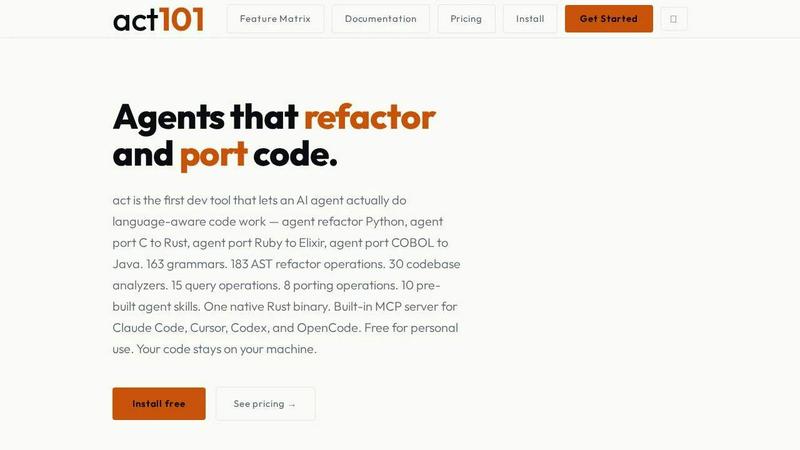
About act101
act101 is a revolutionary developer tool that fundamentally changes how AI coding agents interact with source code. It is the first Model Context Protocol (MCP) server specifically designed to give AI agents the ability to perform language-aware code refactoring and cross-language porting across an unprecedented 163 programming languages. This single native Rust binary contains 183 Abstract Syntax Tree (AST) refactor operations, 30 codebase analyzers, 15 query operations, and 8 porting operations. It is built for developers using AI coding assistants like Claude Code, Cursor, Codex, and OpenCode. The core value proposition is that act101 moves AI agents beyond simple whole-file rewrites into precise, AST-aware code transformations. This means agents can rename symbols across an entire workspace, extract functions while preserving comments and formatting, and port an entire codebase from C to Rust using a state machine approach. Crucially, act101 operates entirely on the user's machine with no telemetry, no indexing, no caching, and no cold starts, ensuring code privacy and providing instant, never-stale results. It is free for personal use, making advanced code transformation accessible to individual developers and open-source projects.
Features of act101
AST-Aware Refactor Operations
act101 provides AI agents with 183 distinct AST-aware refactor operations that go far beyond simple text manipulation. These operations include extract-function, rename-symbol, move-symbol, inline-variable, convert-to-dataclass, extract-trait, add-type-hints, organize-imports, and 176 more. Each operation understands the syntax tree of the target language, meaning it can safely rename a function across an entire Rust workspace, extract a method from a Python class while updating all references, or convert a JavaScript module to TypeScript with proper type annotations. Every operation includes automatic checkpointing and instant undo, giving developers complete confidence in agent-driven changes. This feature eliminates the common problem of AI agents producing broken code through whole-file rewrites that lose comments, break formatting, and have no rollback capability.
Cross-Language Porting State Machine
act101 introduces a sophisticated state machine for end-to-end language migration that is exposed through 8 porting operations. The process begins with port_contract to anchor the source-to-target migration strategy, followed by port_inventory to enumerate every symbol that must be moved. The agent then uses port_order to resolve dependency ordering and a port_manifest state machine with init, add, update, remove, and note operations to track progress step by step. This structured approach works between any two of the 163 supported grammars, enabling migrations such as C to Rust, Ruby to Elixir, or COBOL to Java. The state machine ensures that complex migrations are broken down into manageable, verifiable steps rather than attempted as monolithic rewrites.
Comprehensive Codebase Analyzers
The tool includes 30 built-in codebase analyzers that give AI agents a structural map of the repository before any changes are made. These analyzers cover cohesion, coupling, cycles, chokepoints, hotspots, dead code, layers, seams, clusters, surface area, fan balance, migration readiness, and type completeness. When an agent invokes an analyzer, it receives detailed metrics and structural insights about the codebase, allowing it to make informed decisions about refactoring priorities and migration strategies. This feature transforms AI agents from blind text generators into informed code surgeons who understand the architectural implications of their actions.
Pre-Built Agent Skills
act101 ships with 10 pre-built agent skills that compose the individual refactor, port, analyze, and query operations into common engineering workflows. These skills include architecture-audit, code-review, refactoring, code-navigation, code-generation, migration-assessment, boundary-analysis, change-impact, health-check, and architectural-refactoring. Developers can invoke these skills with simple commands like /skill-name in Claude Code, Cursor, or other MCP-aware clients. Each skill orchestrates the underlying operations in the correct sequence, applying best practices for the specific task. This dramatically reduces the cognitive load on developers who no longer need to manually guide agents through multi-step processes.
Use Cases of act101
Modernizing Legacy Codebases
A development team maintaining a 20-year-old COBOL application needs to migrate it to Java. Using act101, an AI agent can first analyze the entire COBOL codebase to understand its structure, coupling, and dependencies. The agent then uses the porting state machine to systematically translate each module, starting with contract definition, inventorying all symbols, resolving ordering dependencies, and tracking progress through the manifest. The agent can refactor the generated Java code to follow modern patterns, add type hints, and organize imports. This structured approach reduces the risk of the migration project and ensures that business logic is preserved accurately across the language boundary.
Large-Scale Refactoring in Active Projects
A software engineer needs to rename a core interface across a TypeScript monorepo containing hundreds of files. Instead of manually updating each file or trusting an AI to do a whole-file rewrite, the engineer asks their AI agent to use act101's rename-symbol operation. The agent, using the AST-aware operation, renames the interface in every file simultaneously, updates all import statements, and modifies every reference. The operation includes automatic checkpointing, so if the change introduces any issues, the engineer can instantly undo it. This use case demonstrates how act101 enables safe, system-wide refactoring that was previously too risky to automate.
Architectural Analysis for Technical Debt Reduction
A technical lead wants to understand the structural health of a Rust codebase before planning a major refactoring sprint. They instruct their AI agent to run the architecture-audit skill from act101. The agent executes multiple analyzers to measure coupling between modules, identify circular dependencies, find dead code, and locate architectural hotspots. The agent then presents a comprehensive report with specific recommendations for refactoring. This analysis, which would traditionally take days of manual code review, is completed in minutes, allowing the team to prioritize their technical debt reduction efforts with data-driven confidence.
Cross-Language Code Generation and Porting
A startup is building a new service in Elixir but has a large existing Ruby library with proven business logic. Using act101, an AI agent ports the Ruby library to Elixir using the contract, inventory, ordering, and manifest state machine. The agent first analyzes the Ruby code to understand its structure and dependencies, then generates equivalent Elixir modules following idiomatic patterns. The developer can review each step of the migration, with the ability to undo any individual transformation. This use case enables teams to adopt new languages without rewriting proven business logic from scratch.
Frequently Asked Questions
How does act101 ensure code privacy and security?
act101 is designed as a native Rust binary that runs entirely on the user's machine. It performs no telemetry, meaning no code data is ever sent to external servers. The tool does not index or cache the codebase; it parses files on each call, so results are never stale and no persistent data stores are created. The only network communication is for license verification, which does not transmit any source code. This architecture eliminates the supply-chain attack surface associated with plugin runtimes or package graphs, making act101 suitable for working with sensitive or proprietary codebases.
What makes act101 different from using an AI agent's built-in code editing capabilities?
Traditional AI agents edit code by rewriting entire files, which often results in lost comments, broken formatting, and changes that cannot be undone. act101 provides typed, AST-aware operations that understand the syntax and structure of the target language. When an agent uses act101 to rename a symbol, it modifies only the relevant AST nodes across all files, preserving formatting and comments. Every operation includes automatic checkpointing and instant undo, providing a safety net that whole-file rewrites cannot offer. Additionally, act101's operations are significantly more token-efficient, using approximately 85% fewer tokens than file-based operations on average.
Which AI coding assistants are compatible with act101?
act101 is built as a Model Context Protocol (MCP) server, making it compatible with any MCP-aware client. This includes Claude Code, Cursor, Windsurf, Codex, and OpenCode. The tool exposes its operations through a built-in MCP server that the AI assistant connects to, allowing the assistant to call refactor, port, analyze, query, and skill operations as needed. This standards-based approach ensures broad compatibility and future-proofs the tool as new MCP-compatible assistants are developed.
Is act101 free to use and what are the limitations?
act101 is free for personal use, making it accessible to individual developers, students, and open-source contributors. The free tier includes access to all 163 grammars, 183 refactor operations, 30 analyzers, 15 query operations, 8 porting operations, and 10 pre-built agent skills. For commercial or team usage, there are paid pricing tiers that offer additional features and support. The tool can be installed via a simple command-line process, and detailed documentation is available on the act101 website to help users get started quickly.
Pricing of act101
act101 is free for personal use, providing full access to all features including 163 grammars, 183 refactor operations, 30 analyzers, 15 query operations, 8 porting operations, and 10 pre-built agent skills. For commercial and team usage, paid pricing tiers are available. Users can install the free version immediately and explore the pricing page on the act101 website for detailed information about commercial plans, team features, and enterprise support options.
Similar to act101

No-code 2D game editor: visual node logic, drag-and-drop scenes, live preview. Exports to Windows, macOS, Linux, Android, iOS, Web.

Moderation, routing, intent and scoring for any text over one Jev-compatible API, hosted in the EU.

A free directory of 950+ projects built on Laya, the open-source decision model. Updated daily.

A free browser-based toolkit for creating, cutting, converting, and previewing sprite sheet animations.

The #1 Native Form Builder Plugin for Framer - No Code, No Embeds, No External Platforms.

Generate and edit production-ready images with GPT Image 2 API using detailed prompts, reference images, clear text rendering, and developer-friendly

Create videos from prompts and images with RunwayAI, an independent runway ai video generator with practical output controls.
