
Interactive Circle of Fifths vs Polym
Side-by-side comparison to help you choose the right product.

Interactive Circle of Fifths
Master music theory with an interactive Circle of Fifths for scales, chords, and harmonization.
Last updated: March 1, 2026

Polym uses active learning and audio to help you permanently remember essential knowledge.
Last updated: March 1, 2026
Visual Comparison
Interactive Circle of Fifths
Polym
Feature Comparison
Interactive Circle of Fifths
Dynamic Key and Scale Exploration
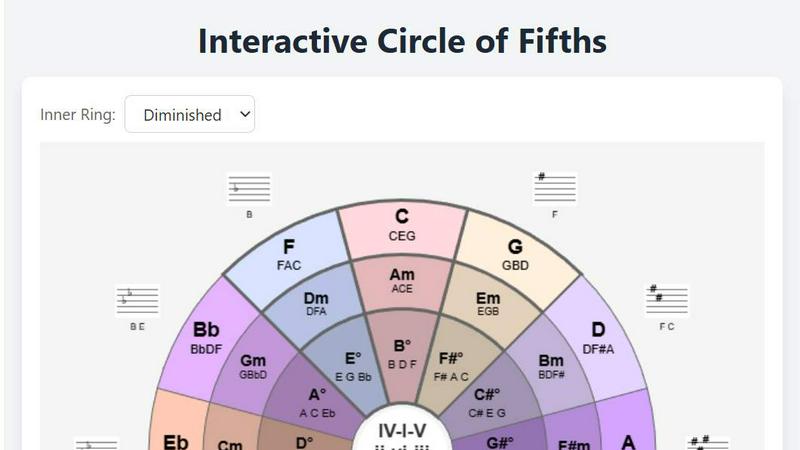
Instantly explore any musical key with a simple click. The tool dynamically updates to display the complete diatonic scale, its notes, and the harmonized chords for that key. Users can also switch between different scale types, including the Pentatonic, Blues, Diatonic, and Diminished scales, providing a comprehensive view of melodic and harmonic possibilities directly from the circle's interface.
Harmonized Scale and Chord Function Panel
This central panel displays all seven chords within the selected key (e.g., C, Dm, Em, F, G, Am, B°), clearly labeled with both their letter names and Roman numeral scale degrees (I, ii, iii, IV, V, vi, vii°). It visually teaches chord function, showing how each chord relates to the tonal center and its typical role in progressions, such as which chords act as the tonic, subdominant, or dominant and where they naturally resolve.
Instrument-Specific Visualizers (Piano & Guitar)
Bridge the gap between theory and practice with dedicated visualizers for piano and guitar. When a chord or key is selected, the tool displays the corresponding notes and fingerings on a virtual piano keyboard and guitar fretboard. This feature is invaluable for translating theoretical knowledge into practical playing, helping musicians learn chord shapes, scales, and progressions on their actual instrument.
Chord Sequencer and Progression Builder
Move beyond theory into active composition with the integrated chord sequencer. Users can drag and drop chords from the harmonized scale panel to create custom progressions. This hands-on feature allows for experimenting with different chord orders, hearing how they sound in sequence, and understanding the emotional flow created by various functional movements, making it a powerful tool for songwriting.
Polym
Medium-Form Audio Courses
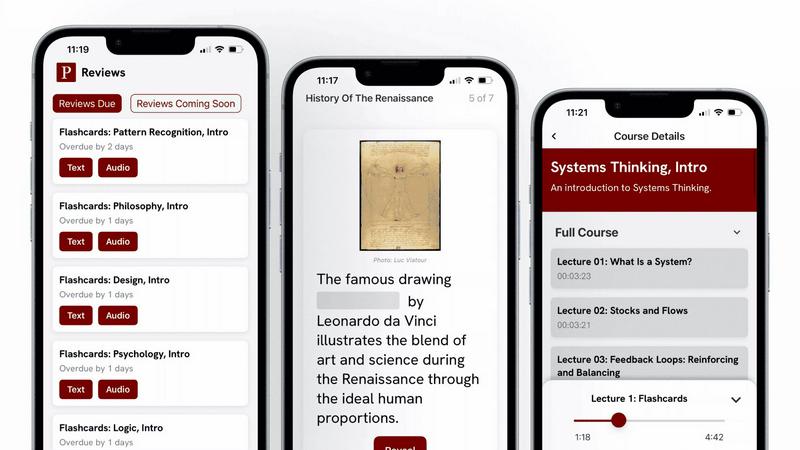
Polym provides in-depth, medium-form audio courses on a curated selection of foundational subjects. These courses are designed to be comprehensive yet digestible, focusing on abstract concepts and practical examples from fields like logic, economics, and computer science. The content is specifically tailored for the audio format, ensuring technical and mathematical concepts are communicated clearly and effectively without relying on visual aids, making complex topics accessible through listening alone.
Active Learning with Audio Flashcards
The app incorporates retrieval practice through interactive audio flashcards. This feature prompts users to actively recall information, strengthening memory pathways and enhancing long-term retention. Unlike passive listening, these flashcards turn review sessions into engaging exercises that test your knowledge, ensuring you move information from short-term to durable long-term memory.
Spaced Repetition System
Polym utilizes a spaced repetition algorithm to schedule review sessions at optimal intervals. This science-backed method strategically prompts you to revisit previously learned material just as you are about to forget it, thereby dramatically increasing memory consolidation. This systematic approach ensures that foundational knowledge sticks with you over weeks, months, and years.
Interleaved Practice Sessions
To enhance learning and build connections between subjects, Polym employs interleaving. Instead of focusing on a single topic in isolation, the app mixes related concepts from different courses during practice sessions. This technique improves your ability to discriminate between ideas and apply knowledge in varied contexts, leading to a deeper, more integrated understanding of the core curriculum.
Use Cases
Interactive Circle of Fifths
Music Theory Education and Homework
Ideal for students in formal education or self-learners. The tool breaks down complex topics like key signatures, scale construction, and chord harmonization into an interactive, visual format. Students can use it to complete theory assignments, verify their answers, and gain a deeper, intuitive understanding of relationships that are difficult to grasp from textbooks alone.
Songwriting and Chord Progression Inspiration
Songwriters experiencing writer's block can use the circle to discover new harmonic pathways. By clicking around different keys and experimenting with the chord sequencer, they can quickly audition countless chord progressions. The clear labeling of chord functions (like "Resolves To") provides immediate ideas for creating tension and release, sparking new musical ideas efficiently.
Instrument Learning and Practice
Guitarists and pianists can use the instrument visualizers as a practice companion. When learning a new song in a particular key, they can reference the tool to see all the diatonic chords and their voicings on their instrument. This aids in memorization, helps understand the song's structure, and allows for improvisation using the correct scale notes.
Music Composition and Arrangement
Composers and arrangers can use the tool to plan modulations and analyze harmonic movement between keys. The Circle of Fifths inherently shows closely related keys, making it easy to find smooth transitional points for key changes in a piece. It serves as a quick reference to ensure theoretical correctness and explore advanced harmonic colors like diminished chords and scales.
Polym
Professional Skill Reinforcement
Professionals in fields like data science, business, or technology can use Polym to solidify their grasp of cross-disciplinary fundamentals such as statistics, probability, and logic. The app's active recall and spaced repetition features ensure that these critical concepts, often learned once and forgotten, become a permanent part of their mental toolkit, directly enhancing analytical and decision-making skills on the job.
Commute & Downtime Learning
Polym transforms otherwise unproductive time—such as daily commutes, workouts, or household chores—into valuable learning opportunities. The audio-first format allows users to engage with medium-form courses or review key terms hands-free, turning idle moments into consistent, progressive study sessions that compound into significant knowledge gains over time.
Foundational Education for Aspiring Polymaths
For individuals passionate about becoming modern-day polymaths, Polym offers a structured and efficient path to building a wide base of essential knowledge. The curated curriculum across philosophy, history, economics, and science provides a coherent foundation, while the app's memory-enhancing design ensures that this broad learning is retained, not just briefly encountered.
Academic Concept Review
Students or lifelong learners can use Polym as a powerful supplement to traditional study. The audio flashcards and abbreviated "term only" courses are perfect for reviewing key definitions, theories, and concepts from complex subjects like AI or philosophy. This auditory reinforcement complements visual study methods and aids in last-minute exam preparation or long-term concept mastery.
Overview
About Interactive Circle of Fifths
The Interactive Circle of Fifths is a comprehensive digital music theory tool that transforms the classic circular diagram from a static reference into a dynamic, hands-on learning and composition aid. It is engineered to visualize and audibly demonstrate the foundational harmonic relationships within Western music. At its core, the tool allows users to explore any musical key with a single click, instantly revealing the corresponding scale, chords, and harmonic functions. Its main value proposition lies in synthesizing complex theoretical concepts—like scale harmonization, chord function, and key relationships—into an intuitive, interactive visual and auditory experience. Designed for a wide audience, it serves music students grappling with theory basics, educators seeking a clear teaching aid, and seasoned composers or songwriters who need quick inspiration and verification for their chord progressions and modulations. By integrating instrument-specific visualizers for piano and guitar, it effectively bridges the gap between abstract music theory and practical instrument knowledge, making advanced musical understanding accessible, engaging, and immediately applicable for all skill levels.
About Polym
Polym is a specialized audio application engineered to transform passive listening into an active, science-backed learning experience. Its core mission is to help lifelong learners build and, more importantly, retain a robust foundation of essential knowledge across key disciplines. The app moves beyond traditional audiobooks or podcasts by integrating proven cognitive science principles—specifically retrieval practice, spaced repetition, and interleaving—directly into its content structure and delivery. Polym offers a curated curriculum of medium-form audio courses, abbreviated summaries, and interactive audio flashcards in foundational subjects like Statistics, Probability, Logic, Economics, Computer Science, AI, Philosophy, and History. It is meticulously designed for curious minds, professionals seeking to solidify cross-disciplinary fundamentals, and aspiring polymaths who want to efficiently learn and remember key concepts. By transforming commutes, workouts, or downtime into productive, reinforced learning sessions, Polym empowers users to not just consume information but to truly internalize it for the long term, effectively combating the natural process of forgetting.
Frequently Asked Questions
Interactive Circle of Fifths FAQ
What is the Circle of Fifths?
The Circle of Fifths is a fundamental music theory diagram that visually represents the relationships between the 12 tones of the chromatic scale, their corresponding key signatures, and the relative major and minor keys. It is arranged in a circle where each step clockwise moves up a perfect fifth (or down a perfect fourth). This tool makes that static diagram interactive and sonically explorable.
Who is this tool designed for?
The Interactive Circle of Fifths is designed for anyone engaged with music, from absolute beginners to professional musicians. It is particularly useful for music students, teachers, songwriters, composers, and instrumentalists (especially guitarists and pianists) who want to deepen their theoretical understanding and apply it directly to playing, writing, or analyzing music.
How do the instrument visualizers work?
When you select a key or a specific chord, the tool automatically updates the piano and guitar visualizers. On the piano, the relevant keys are highlighted. On the guitar, a fretboard diagram shows common chord shapes and scale patterns. This allows you to see exactly how the theoretical concept translates to your instrument's layout, aiding in memorization and practical application.
Can I use this tool to help me improvise?
Absolutely. By selecting a key, you can see the corresponding scale (like the major scale or blues scale) and its notes. The instrument visualizers then show you where those notes are located on the fretboard or keyboard. This provides a solid framework for improvisation, ensuring your notes are harmonically correct within the chosen key or chord progression.
Polym FAQ
What research supports the learning strategies Polym uses?
Polym's methodology is grounded in well-established cognitive science. Key strategies like retrieval practice, spaced repetition, and interleaving are extensively researched and proven to significantly enhance long-term memory retention and recall compared to passive study methods. You can explore foundational research on these techniques through resources like the National Institutes of Health (e.g., https://www.ncbi.nlm.nih.gov/pmc/articles/PMC9781761/).
What subjects does Polym cover?
Polym offers a curated curriculum focused on foundational knowledge applicable across many fields. Current subjects include Logic, Logical Fallacies, Cognitive Biases, Statistics, Probability, Scientific Research, Algorithms, Economics, Philosophy, and History. The selection is designed to be relevant both professionally and for general intellectual enrichment.
Who is Polym designed for?
Polym is built for anyone who wants to efficiently learn and remember essential knowledge. This includes curious lifelong learners, professionals aiming to strengthen cross-disciplinary fundamentals, students seeking supplemental review, and aspiring polymaths who value a broad and retained understanding of key subjects that impact both professional and everyday life.
When is Polym available?
Polym is officially launched and available for download now. The app can be installed on both iOS and Android devices, allowing users to immediately start their journey toward more effective and lasting learning through its science-backed audio platform.
Alternatives
Interactive Circle of Fifths Alternatives
The Interactive Circle of Fifths is a comprehensive digital music theory tool in the Education & Learning category. It transforms the classic diagram into a dynamic, interactive experience for exploring scales, chords, and harmonic relationships across different keys, complete with auditory feedback and instrument visualizers. Users may seek alternatives for various reasons, including budget constraints, a need for different feature sets, or specific platform compatibility. Some may prefer a purely physical reference, a more simplified interface, or a tool integrated into a broader music production suite. When evaluating alternatives, consider your primary learning or compositional goals. Key factors include the depth of theoretical information provided, the quality of instrument-specific visual aids like fretboard or keyboard diagrams, the tool's usability, and whether it offers the auditory components essential for connecting theory to sound.
Polym Alternatives
Polym is a specialized audio learning app designed to help users permanently retain foundational knowledge across subjects like economics, computer science, and philosophy. It belongs to the educational technology category, focusing on active learning and long-term memory retention through structured audio content. Users may explore alternatives for various reasons, such as different pricing models, a need for video or text-based content, a preference for a different subject matter focus, or specific platform availability. The search for a different tool often stems from individual learning styles, budget constraints, or the desire for a broader or more niche curriculum. When evaluating alternatives, key considerations include the core learning methodology (passive vs. active), content format and depth, subject coverage, cost structure, and the platform's overall approach to combating the forgetting curve. The goal is to find a solution that effectively aligns with your personal learning objectives and habits.