
Mod vs OpenMark AI
Side-by-side comparison to help you choose the right product.

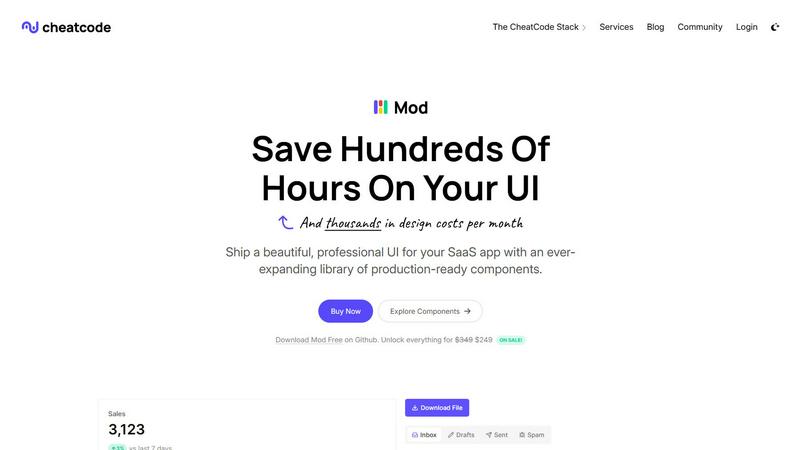
Mod is a CSS framework with prebuilt components for rapidly developing SaaS application interfaces.

OpenMark AI benchmarks over 100 LLMs on your specific task for cost, speed, quality, and stability without requiring API keys.
Last updated: March 26, 2026
Visual Comparison
Mod
OpenMark AI
Feature Comparison
Mod
Extensive Component Library
Mod provides an extensive library of over 88 meticulously crafted, reusable UI components. This includes everything from foundational elements like buttons, forms, and modals to complex SaaS-specific modules such as data tables, pricing cards, dashboards, and user profile sections. Each component is built with accessibility and semantic HTML in mind, ensuring a solid foundation for any application. This vast selection allows developers to assemble complex interfaces quickly by combining these pre-styled building blocks, ensuring consistency and saving countless hours of development time.
Comprehensive Design System with Multiple Themes
Beyond individual components, Mod offers a complete, cohesive design system featuring 168 distinct style utilities and two fully realized themes (light and dark). This system includes a consistent spacing scale, typography hierarchy, color palette, and shadow elevations. The built-in, easy-to-implement dark mode support is a significant advantage for modern applications. This comprehensive approach guarantees that every element you use from the library works harmoniously with every other, delivering a polished and professional look right out of the box.
Framework-Agnostic & Easy Integration
A standout feature of Mod is its framework-agnostic architecture. It is designed as pure, well-structured CSS with clear class names, making it compatible with any front-end framework or backend templating system. Whether you are building with Next.js, Nuxt, Vite, SvelteKit, Ruby on Rails, Django, or plain HTML, Mod integrates seamlessly. This flexibility prevents vendor lock-in and allows teams to adopt Mod regardless of their chosen technology stack, making it a future-proof investment for any project.
Mobile-First & Fully Responsive
Every component and layout in Mod is built with a mobile-first, responsive design philosophy. The styles and components automatically adapt to provide an optimal viewing and interaction experience across a wide range of devices, from smartphones to desktop monitors. This eliminates the need for developers to write complex media queries and manually adjust layouts for different screen sizes. You can confidently build your SaaS UI knowing it will look and function perfectly for all users, regardless of how they access your application.
OpenMark AI
Plain Language Task Configuration
You can define the exact task you want to benchmark using simple, descriptive language without writing complex code or scripts. The platform guides you through setting up the prompt, expected output format, and evaluation criteria. This intuitive interface makes sophisticated benchmarking accessible to both technical and non-technical team members, ensuring the test accurately reflects the real-world use case you intend to build.
Multi-Model Comparative Analysis
Run your defined task against a wide selection of models simultaneously in one coordinated session. OpenMark AI manages the API calls to all providers, presenting results in a unified, side-by-side dashboard. This allows for direct comparison of performance metrics across different model families and vendors, providing a clear, holistic view of which model excels specifically for your needs, rather than generic benchmarks.
Real Cost & Performance Metrics
The platform reports actual, incurred costs from real API calls and measures true latency, giving you accurate financial and operational data for planning. More importantly, it scores output quality based on your task's criteria and runs multiple iterations to show stability and variance. This reveals not just if a model can get the task right once, but how consistently it performs and what the reliable cost-to-quality ratio is.
Hosted Benchmarking with Credits
OpenMark AI operates on a credit system, eliminating the need for users to provision, manage, and pay for separate API keys from multiple AI providers. This significantly reduces setup complexity and administrative overhead. You purchase credits from OpenMark and consume them to run benchmarks, streamlining the entire testing workflow and enabling rapid, secure experimentation without configuring external accounts.
Use Cases
Mod
Rapid Prototyping and MVP Development
For startups and entrepreneurs, speed to market is critical. Mod is an ideal tool for rapidly prototyping ideas and building Minimum Viable Products (MVPs). Developers can use the pre-designed components to construct a fully functional, professional-looking interface in a fraction of the time it would take to design and code from zero. This allows teams to validate their business concept with real users quickly without compromising on the perceived quality and polish of the application.
Standardizing UI Across Development Teams
In growing engineering teams, maintaining visual consistency across different features and modules developed by multiple engineers can be challenging. Mod acts as a single source of truth for the UI. By adopting Mod's design system, teams ensure that every new page, component, or feature adheres to the same spacing, typography, and color rules. This standardization improves collaboration, reduces design review cycles, and ensures a uniform user experience throughout the entire application.
Enhancing Legacy Applications with Modern UI
Many established applications have robust backend functionality but suffer from outdated or inconsistent front-end interfaces. Mod provides a perfect solution for modernizing these legacy UIs without a complete rewrite. Developers can incrementally replace old styles and components with Mod's modern, responsive ones. Since Mod works with any stack, it can be integrated into older Rails, Django, or even jQuery-based applications to give them a fresh, contemporary SaaS look and feel.
Building Internal Admin Dashboards and Tools
Companies often need to build internal tools, admin panels, or customer portals that require a clean, functional interface but don't justify the cost of a dedicated designer. Mod's component library, especially its data tables, charts, and form elements, is perfectly suited for this use case. Developers can efficiently assemble powerful internal dashboards that are both usable and professional, allowing the business to operate more effectively without diverting design resources from customer-facing products.
OpenMark AI
Pre-Deployment Model Selection
Before integrating an LLM into a production feature, development teams can use OpenMark AI to empirically test candidate models on prototypes of their actual tasks. This validates which model delivers the required accuracy, tone, and format at an acceptable cost and latency, ensuring a confident, evidence-based selection that aligns with both technical and business requirements prior to shipping.
Cost Efficiency Optimization
For applications with high-volume or recurring AI usage, even small cost differences per request can have major financial implications. OpenMark AI helps identify the most cost-effective model that still meets quality thresholds. Teams can compare the real API cost against scored output quality to find the optimal balance, moving beyond just selecting the model with the cheapest listed token price.
Consistency and Reliability Validation
Testing a model's output across multiple runs is crucial for features requiring deterministic or highly reliable behavior. OpenMark AI's stability analysis shows variance in responses, helping teams avoid models that are inconsistent or prone to erratic outputs. This is essential for building user trust in AI-powered features like customer support, content moderation, or data processing.
Agent Routing and Workflow Design
When designing complex AI agent systems where different tasks are routed to specialized models, OpenMark AI is ideal for benchmarking each sub-task. Teams can determine the best model for classification, the best for summarization, and the best for creative generation within the same workflow, creating an optimized and cost-aware multi-model architecture based on empirical data.
Overview
About Mod
Mod is a comprehensive, production-ready CSS framework and component library specifically engineered for building modern, polished Software-as-a-Service (SaaS) user interfaces. It provides developers with a systematic design system that eliminates the need for custom CSS from scratch, dramatically accelerating the front-end development process. The core value proposition of Mod is to empower solo developers, startups, and engineering teams to ship professional, visually cohesive, and highly functional web applications faster and with significantly reduced design overhead. By offering a vast library of pre-built, responsive components and utilities, Mod ensures that the final product maintains a high-quality, consistent aesthetic without requiring deep expertise in UI/UX design. Its framework-agnostic nature makes it a versatile tool that seamlessly integrates into virtually any modern tech stack, from JavaScript frameworks like Next.js and Svelte to backend-heavy environments like Rails and Django. With Mod, the focus shifts from wrestling with styling and layout to implementing core application logic and features.
About OpenMark AI
OpenMark AI is a comprehensive, web-based platform designed for task-level benchmarking of Large Language Models (LLMs). It empowers developers, product teams, and AI practitioners to make data-driven decisions when selecting AI models for their applications. The core value proposition is moving beyond theoretical datasheets and marketing claims to evaluate models based on real performance for a specific task. Users describe their objective in plain language—such as data extraction, classification, or creative writing—and OpenMark AI executes the same prompts across a vast catalog of over 100 models in a single session. The platform provides a systematic comparison across critical dimensions: the scored quality of outputs, the actual cost per API request, latency, and crucially, the stability of results across multiple runs to reveal variance. This eliminates the guesswork and risk of relying on a single, potentially "lucky" output. By using a hosted credit system, it removes the friction of configuring and managing multiple API keys from providers like OpenAI, Anthropic, and Google, streamlining the pre-deployment validation process to ensure the chosen model is cost-efficient, reliable, and fit-for-purpose.
Frequently Asked Questions
Mod FAQ
What frameworks is Mod compatible with?
Mod is completely framework-agnostic. It is built with standard CSS and uses simple class names for styling, making it compatible with any front-end or full-stack framework. This includes popular JavaScript frameworks like Next.js, Nuxt, Svelte, and Vue, build tools like Vite, and backend frameworks with templating engines like Ruby on Rails, Django, Laravel, and Phoenix. You can use it with static HTML sites as well.
Does Mod include JavaScript for interactive components?
No, Mod is primarily a CSS framework and component library. It provides the complete styles, layouts, and visual states (like hover and focus) for all 88+ components. For interactive behavior (e.g., opening a modal, toggling a dropdown, submitting a form), you will use your chosen framework's native JavaScript or a dedicated UI library. This separation of concerns gives developers maximum flexibility to implement logic in the way that best suits their project.
How is dark mode implemented with Mod?
Mod includes full, built-in support for dark mode through the use of CSS custom properties (variables) and the prefers-color-scheme media query. The framework comes with two complete themes: light and dark. By applying Mod's provided CSS classes to your root HTML element, the components will automatically switch their color palette based on the user's system preference. You can also easily implement a manual theme switcher in your application to override system settings.
What is included in the yearly updates?
Purchasing a license for Mod includes access to yearly updates, which ensure your projects stay current with modern design trends and web standards. These updates typically include new components, additional style variants, enhancements to existing components for better accessibility or performance, and updates to the underlying CSS utilities. This subscription model provides ongoing value and helps keep your SaaS UI looking fresh and competitive over time.
OpenMark AI FAQ
How does OpenMark AI score the quality of model outputs?
OpenMark AI uses the evaluation criteria you define when setting up your task to score outputs. This can involve automated checks for format correctness, keyword presence, or semantic similarity to a reference answer, as well as manual scoring rubrics. The platform aggregates scores across multiple runs to provide a reliable quality metric tailored to your specific success criteria.
Do I need my own API keys to use OpenMark AI?
No, you do not need to configure separate API keys from OpenAI, Anthropic, Google, or other providers. OpenMark AI operates on a hosted credit system. You purchase credits through OpenMark and use them to run benchmarks. The platform manages all the underlying API calls and costs, simplifying the process and centralizing billing.
What is the difference between a single run and testing for stability?
A single run gives you one data point, which could be an outlier or "lucky" output. Testing for stability involves running the same prompt against the same model multiple times. OpenMark AI shows the variance in cost, latency, and quality scores across these repeat runs, giving you a realistic understanding of the model's consistency and reliability in production.
What kinds of tasks can I benchmark with OpenMark AI?
You can benchmark a wide variety of tasks, including but not limited to text classification, translation, data extraction from documents, question answering, content generation, summarization, code writing, and agent-based reasoning. The platform is designed to be flexible, allowing you to describe and test virtually any prompt-based task you would send to an LLM.